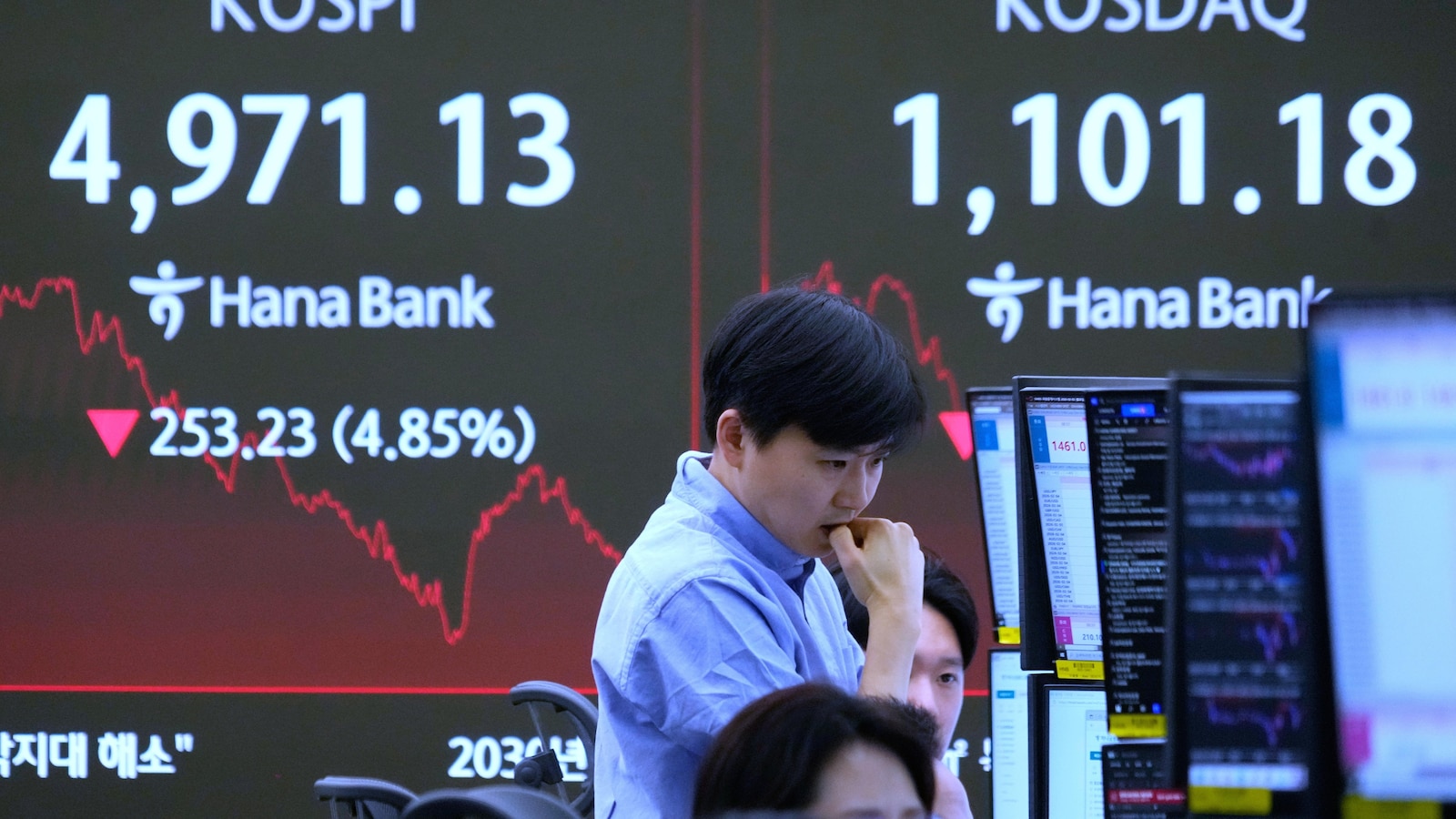
Global risk assets slid in a tech-led sell-off as bitcoin plunged as much as 8% (trading near $71,000 after hitting ~$69,000, its lowest since Nov 2024) and South Korea’s Kospi tumbled 3.9% to 5,163.57; major tech names were hit hard (AMD -17.3%, Samsung Electronics -5.9%, SK Hynix -6.7%) while some AI-exposed names outperformed (Super Micro +13.8%). U.S. indices were mixed (S&P 500 -0.5 to 6,882.72, Nasdaq -1.5 to 22,904.58, Dow +0.5 to 49,501.30) as investors reacted to elevated tech valuations, weaker-than-expected guidance and specific earnings misses (e.g., Uber -5.1). Commodity and FX moves accompanied the risk-off tone: WTI down $1.37 to $63.77, Brent down $1.47 to $67.99, gold -0.3%, silver -7%, dollar at 157.00 yen and euro $1.1790.
Market structure: The sell-off concentrates losses in high-valuation, momentum tech names (AMD -17% intraday, SK Hynix -6.7%, Samsung -5.9%) while beneficiaries are AI-infrastructure suppliers and defensive retail (SMCI +13.8, WMT +0.2). This compresses growth multiples and raises short-term funding/rehypothecation stress for levered momentum players; expect 5–15% realized/IV decompression in single-name tech over the next 1–4 weeks. Cross-asset: risk-off pressure pushes safe-haven flows into USD and treasuries (downward pressure on global yields) and drags oil (-$1.3) and gold/silver volatility; bitcoin’s -7% quick shock increases crypto-tail risk for correlated equity desks.
Risk assessment: Immediate risk (days) is momentum unwinding and option gamma cascades that can amplify intraday moves; short-term (weeks) risk is earnings-guidance disappointment in Q1 2026; long-term (quarters) risk centers on AI adoption bifurcating winners from losers and potential regulatory actions on crypto/AI. Hidden dependencies: funding/prime-broker liquidity and concentrated passive/ETF rebalances can create transient dislocations >20% in small-cap tech. Catalysts that reverse the trend: dovish guidance from Big Tech (NVDA/AAPL beats), BOP/ETF reflows into AI hardware, or a macro-driven liquidity injection within 2–6 weeks.
Trade implications: Tactical long in AI-infrastructure (SMCI, NVDA) and defensive consumer (WMT) while hedging overall beta is preferred; short selective high-multiple software/mobility (UBER) or use put structures on AMD. Use pairs to isolate exposures (long SMCI / short AMD to play server demand vs client CPU cycle). Options: buy systematic index put spreads for 4–8 week protection and buy 1–3 month single-name puts (AMD, UBER) sized 0.5–2% each to hedge.
Contrarian angles: The market likely oversold quality AI exposure after earnings beats (AMD case) — a 10–25% pullback in winners may be a buying window, not a regime change. Conversely, SMCI’s spike could overshoot fundamentals; use partial profit-taking and longer-term conviction only if backlog visibility sustains 2+ quarters. Historical parallel: 2018/2020 tech pullbacks showed rapid mean reversion once guidance normalized; watch 2–6 week guidance season and positioning data for confirmation.
AI-powered research, real-time alerts, and portfolio analytics for institutional investors.
Request DemoOverall Sentiment
strongly negative
Sentiment Score
-0.65
Ticker Sentiment
