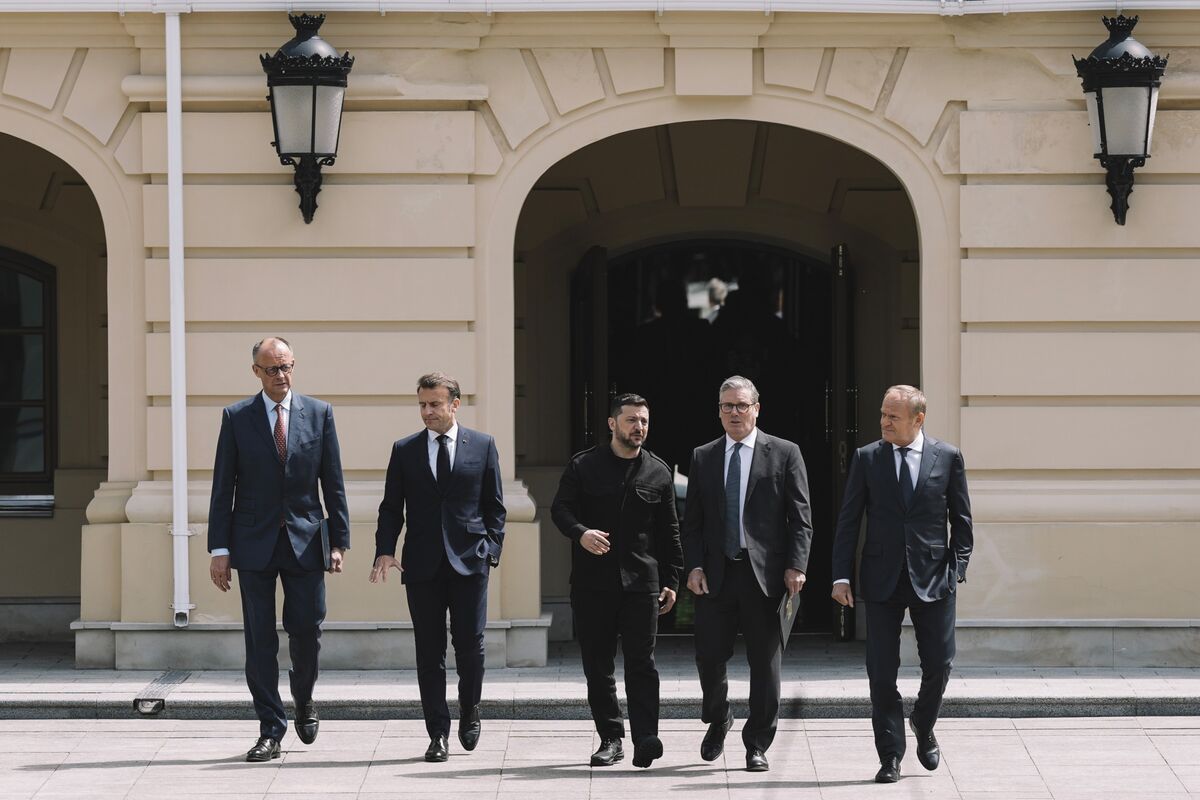
UK Prime Minister Keir Starmer is hosting Ukrainian President Volodymyr Zelenskiy with France’s Emmanuel Macron and Germany’s Friedrich Merz in an effort to steer fragile US-led peace talks toward a resolution that protects Ukraine. The high-level diplomatic push highlights continued Western coordination amid unsettled negotiations—an outcome that, if it changes the conflict trajectory, could affect risk sentiment and have secondary implications for energy and defense-related assets.
Market structure: Short-term winners are defense and security suppliers (US large-caps and European prime contractors), cyber-intel vendors, and logistics/MRO firms as governments signal durability of procurement cycles; losers would be energy exporters if a credible peace lowers risk premia. Expect a 6–24 month window where confirmed NATO/EU procurement commitments could lift orderbooks by mid-single digits (3–7% incremental spend) for primes, levering margins via higher utilization and RFP backlog conversion.
Risk assessment: Tail risks include a breakdown of talks that triggers sanctions/energy cutoffs, which could spike Brent >20% and push core sovereign yields lower as safe-haven demand surges; conversely, a rapid, verifiable de-escalation could compress risk premia and cut commodity-driven inflation by ~5–10% over 3 months. Key hidden dependencies: US election dynamics and EU budget ratification timelines (30–90 days) that determine funding flow; catalysts are formal procurement announcements, security guarantees, and tranche payments.
Trade implications: Favor conviction in defense longs (primes/ETFs) sized to 2–4% of risk budget with 6–12 month horizons; hedge directional commodity exposure with options and trim equity cyclicals sensitive to travel/energy. Cross-asset: buy EUR/GBP vs USD on improved European political coordination if EU announces joint guarantees within 60 days; buy core EU sovereigns selectively on an escalation-driven flight-to-quality.
Contrarian angles: Consensus may underprice protracted low-intensity conflict — markets often cut defense forward earnings growth too quickly after tentative peace signals. Mispricings likely in smaller-cap defense subcontractors and European primes without recent contract wins; unintended consequence: sustained defense capex could crowd out green infrastructure, keeping inflation and real rates higher than consensus expects over 12–24 months.
AI-powered research, real-time alerts, and portfolio analytics for institutional investors.
Request DemoOverall Sentiment
neutral
Sentiment Score
-0.10
