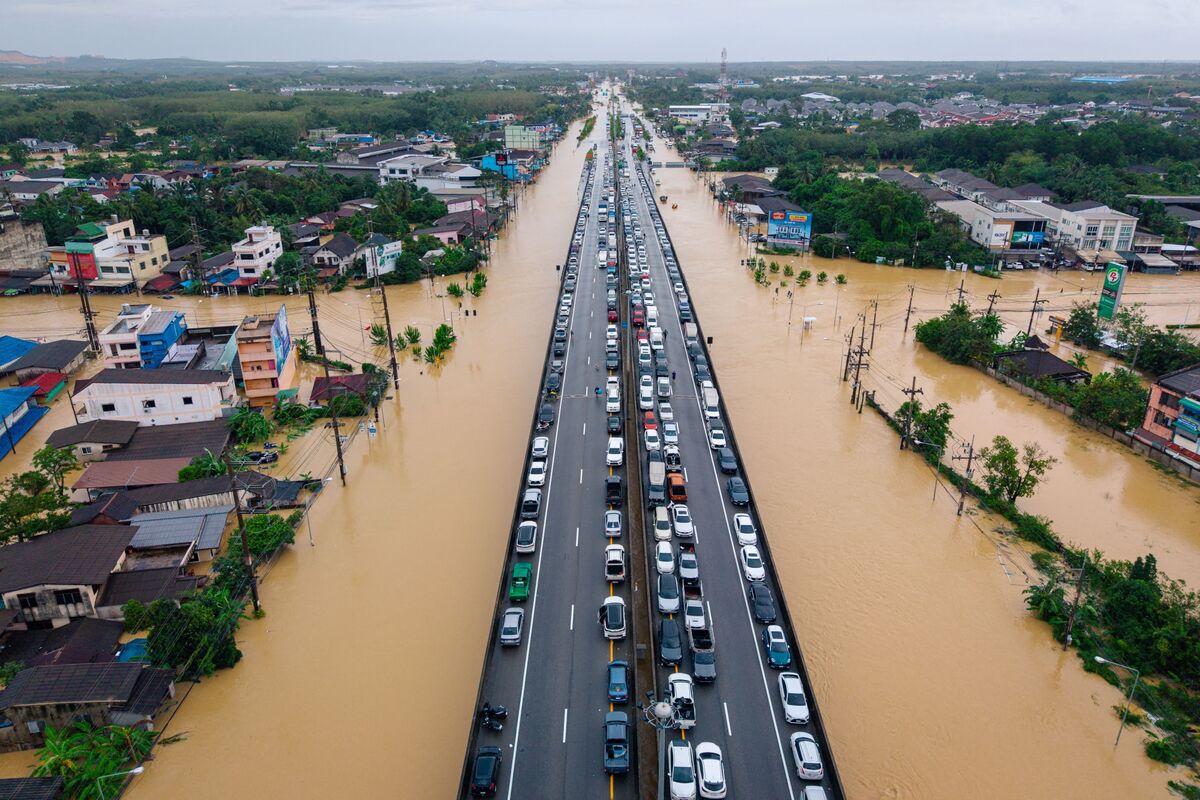
Thailand’s government announced targeted relief after one of the country’s worst floods in decades, allocating 9,000 baht (about $281) per affected household as officials seek to contain economic losses and criticism. Finance Minister Ekniti Nitithanprapas framed the measures weeks before an anticipated snap election, raising near-term fiscal outlays and political risk that could influence investor sentiment toward Thai assets and the government’s economic stewardship.
Market structure: Flooding creates a clear short-term transfer of demand from tourism/retail to reconstruction, agricultural recovery and logistics. Winners are domestic materials & construction (cement, steel, heavy equipment) and agricultural input suppliers; losers include regional tourism (airlines, airports AOT.BK), property insurers and small retailers. Fiscal relief of 9,000 baht/household implies a visible but modest budget hit—if 0.5–2.0m households are affected, cost ≈4.5–18bn baht (~0.03–0.1% of GDP), so macro stress is manageable but concentrated sectoral stress is high over weeks–months.
Risk assessment: Tail risks include prolonged flooding disrupting export supply chains (rice/rubber) for multiple quarters, political backlash prompting larger fiscal stimulus before snap elections, or a sharp rise in insurance losses that stresses regional banks. Immediate (days) risk: consumer spending drop and tourism cancellations; short-term (weeks–months): reconstruction spending and credit upticks in construction; long-term (quarters): potential election-driven fiscal expansion or policy shifts. Hidden dependencies: port/road damage can propagate to export volumes and commodity prices; election timing could amplify volatility.
Trade implications: Favor small-cap domestic cyclicals tied to rebuilding (3–9 month horizon) and commodity exposure to rice/rubber; underweight Thai tourism and property insurers for 1–3 months. Use FX and sovereign-duration hedges: expect THB weakness of 1–3% and 10–30bp widening in 2–5y yields on headline risk. Options: buy puts on Thailand equity ETF (THD) to hedge near-term downside while taking long exposure to construction names.
Contrarian angles: Consensus may over-discount Thailand for months, creating a 6–12 month buying opportunity in tourism and airport names post-reconstruction when travel rebounds; historical parallels (post-disaster reconstruction in Japan/Chile) show outsized mid-cycle returns in materials and select financials. Risk is execution: politicized procurement or bigger-than-expected fiscal strain could delay recovery, so size positions with event-driven stop-losses and catalyst-based exits.
AI-powered research, real-time alerts, and portfolio analytics for institutional investors.
Request DemoOverall Sentiment
moderately negative
Sentiment Score
-0.30
