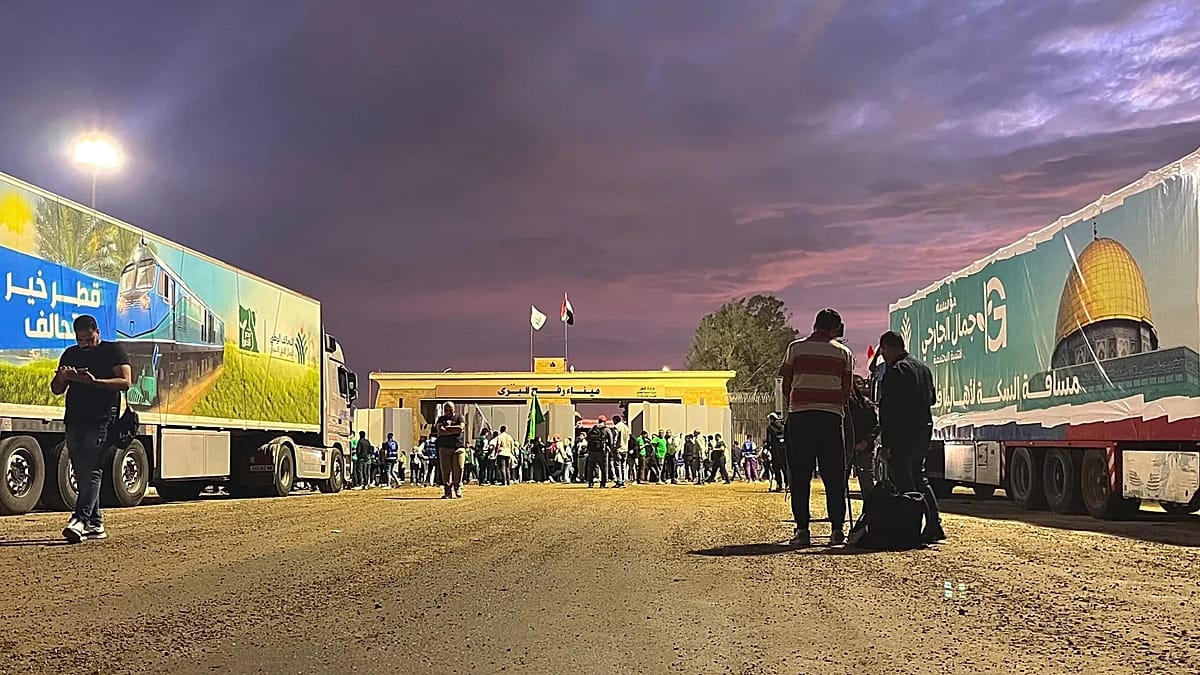
Israel will reopen the Rafah pedestrian crossing with Egypt on a limited, vetted basis starting Sunday, supervised by EU border patrols, marking a step in the US-brokered ceasefire plan and the second phase of reconstruction discussions. Initial movements will prioritise medical evacuees and returnees — reportedly 50 medical evacuees exiting and 50 returnees entering — after the crossing had been nearly closed since May 2024; Israel will continue screenings in an Israeli-controlled corridor. The move eases some humanitarian pressure (tens of thousands displaced, ~18,000–20,000 patients needing treatment abroad) but Israel’s insistence on disarming Hamas and destroying tunnels keeps reconstruction and broader normalisation contingent on security outcomes, maintaining geopolitical risk for regional exposures.
Market structure: The limited reopening of Rafah is an incremental restoration of a land bridge that pre-war moved ~32k trucks/year (~200 trucks/day on open days); initial throughput (tens of people, dozens of evacuees) is immaterial for global trade but meaningful for regional logistics, healthcare evacuations and reconstruction procurement. Winners are defense contractors, regional logistics providers, and construction-materials suppliers if flows scale to even ~50–200 trucks/day; losers are short-duration humanitarian suppliers and insurers exposed to operational disruption if Israeli corridor controls tighten.
Risk assessment: Tail risks center on a ceasefire collapse or a targeted attack on the crossing—low probability but could widen Israeli sovereign spreads by 30–100bps and push Brent +3–6% within days. Timeline: immediate (days) — humanitarian/evacuee flows and headlines; short-term (weeks–months) — phased import of medical supplies and limited construction inputs; long-term (quarters–years) — reconstruction decisions hinge on demilitarization and political settlement, keeping Rafah a geopolitical choke point.
Trade implications: The setup favors tactical long protection/defense exposure and selective materials cyclicals while keeping macro hedges for commodity and credit volatility. Catalysts to add risk are sustained throughput (7‑day averages >200 people/day or >50 trucks/day) and any formal reconstruction funding announcements; reverse if Israel reasserts full closure or if negotiations collapse.
Contrarian angles: Consensus treats reopening as humanitarian only; the market underprices the optionality that steady daily truck volumes (moving from tens to >100/day) would create predictable multi-month demand for cement/steel and logistics. Conversely, reconstruction remains politically conditional — overpaying for regional equities is risky; prefer option-structured exposure to asymmetrically capture upside while capping downside.
AI-powered research, real-time alerts, and portfolio analytics for institutional investors.
Request DemoOverall Sentiment
mildly positive
Sentiment Score
0.10
