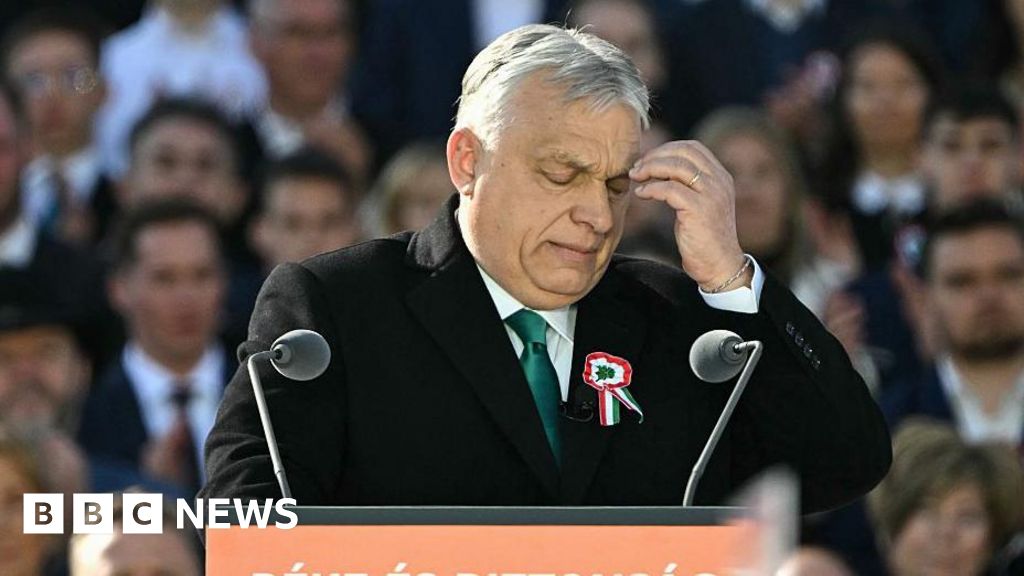
Viktor Orbán, Hungary's prime minister for 16 years, faces his toughest test in the 12 April election with most polls indicating he may be defeated by former insider Péter Magyar. Long-running EU concerns over rule-of-law and corruption have led to repeated warnings and frozen funds, and Orbán's veto has placed roughly €90bn in Ukraine-related EU funds on hold, raising geopolitical friction and material political risk for Hungarian assets and EU funding flows.
Markets face a low-probability, high-consequence political binary in Central Europe that will transmit to credit, FX and sector flows within hours of the election outcome and crystallize over 1–6 months. A short-term victory for the opposition would likely trigger a rapid technical unwind: expect HUF appreciation (mid-single to low-double digits) and sovereign spread compression as conditional EU disbursements and project financing re-enter the pipeline; the converse outcome will amplify capital flight into safe-haven currencies and raise funding costs for state-linked corporates by hundreds of basis points.
Second-order winners/losers are sector-specific rather than purely political. Construction, real-estate developers and state-capital-linked suppliers that rely on EU pre-financing and discretionary public contracts are most exposed to a prolonged funding freeze; their orderbooks can rebase within 2–4 quarters. Conversely, energy exporters and sanctioned-adjacent suppliers see asymmetric optionality: a sustained sclerosis of EU cohesion increases near-term pricing power for non-EU energy routes, while a rapid political normalization removes that upside and reallocates procurement toward Western defense and civil contractors.
Key catalysts and time horizons are discrete: immediate intraday FX/flow moves on election result, 2–6 week political coalition/ministerial formation that determines negotiation posture with Brussels, and a 3–12 month window where legal/administrative actions either unlock or permanently delay EU conditional funds. Tail risks include escalatory sanctions or legal judgements that force asset seizures or large fines — low probability but capable of inflicting multi-quarter revenue shocks on affected Hungarian incumbents. The consensus of a one-way drift away from EU markets understates the re-engagement option: political pragmatism and conditionalism create a path for rapid normalization if mutual economic pain becomes acute.
AI-powered research, real-time alerts, and portfolio analytics for institutional investors.
Request DemoOverall Sentiment
mildly negative
Sentiment Score
-0.35
