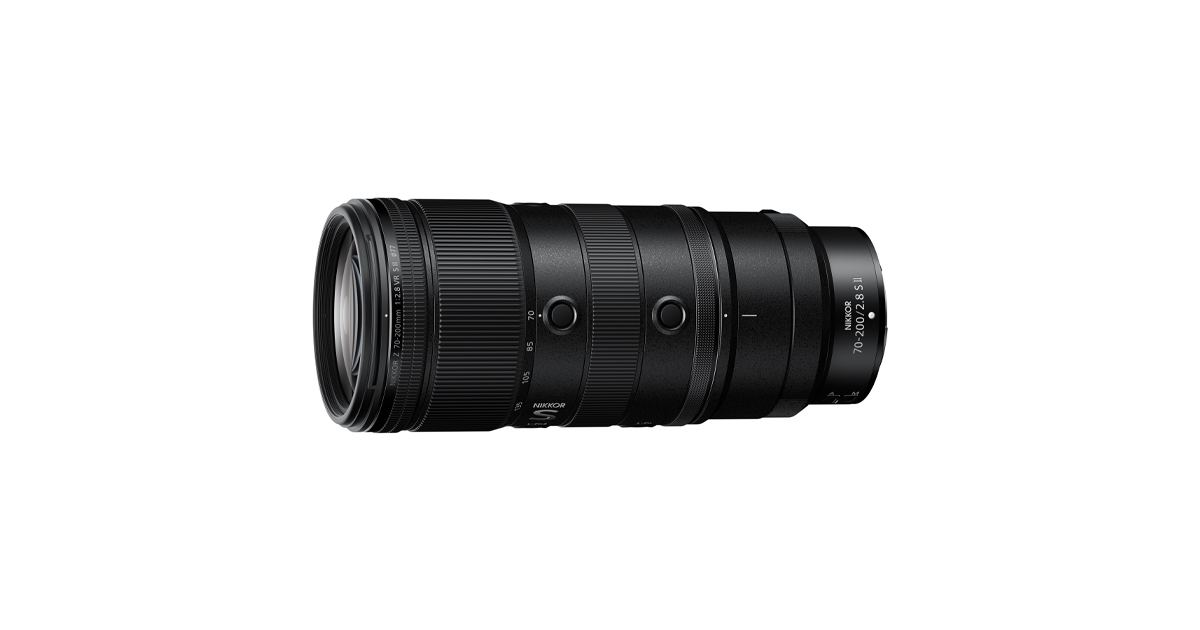
Nikon announced the NIKKOR Z 70-200mm f/2.8 VR S II on Feb. 24, 2026 — a full-frame telephoto zoom claiming the lightest-in-class weight of 998 g (excluding tripod collar and cover), roughly 26% lighter than the 2020 predecessor. The lens retains a constant f/2.8 aperture, adds a Silky Swift VCM AF system delivering ~3.5x faster autofocus and ~40% better AF tracking with zooming, and offers 6.0-stop VR (with Synchro VR), minimum focus of 0.38 m–0.8 m, and compatibility with 1.4x/2.0x teleconverters. The release bolsters Nikon’s S-Line competitiveness in high-end mirrorless optics and may support incremental demand for the imaging segment, but contains no sales or guidance and is unlikely to materially move Nikon’s stock on its own.
Market structure: Nikon’s new NIKKOR Z 70-200mm f/2.8 S II (998 g, ~26% lighter; AF ~3.5x faster; 40% better tracking) directly benefits Nikon (7731.T), pro/videographer-centric rental houses, and gimbal/stabilizer vendors that value lighter optics. Competitors Canon (7751.T) and Sony (6758.T) face incremental pressure in the high-margin pro telephoto zoom niche; market-share shifts are likely modest initially but meaningful in commercial sports/video verticals over 12–24 months.
Risk assessment: Near-term downside is small — product launches seldom move fundamentals in days — but tail risks include supply-chain shocks (neodymium magnet or specialty glass shortages), patent/IP disputes, or a macro consumer-spend pullback that reduces premium-lens demand. Time horizons: negligible market reaction immediate (days), potential revenue inflection in quarters (3–9 months), durable share shifts if Nikon builds lens momentum (12–36 months).
Trade implications: The clearest direct play is a concentrated, size-controlled long in Nikon versus Canon/ Sony shorts to capture relative share gains; use options to limit downside around earnings/quarterly shipment prints. Cross-asset: expect tiny JPY stabilization if Nikon’s export mix improves; commodity exposure (rare-earth prices) could flare if adoption of VCM tech scales globally.
Contrarian angles: Consensus may underprice creator-market upside — lighter, faster AF lenses are disproportionately valuable to video/content creators, not just sports pros, expanding TAM by an estimated 5–10% for mirrorless interchangeable lenses over 2 years. Conversely, investors may overvalue a single-lens story; success depends on camera-body attach rates and inventory execution, so product alone doesn’t guarantee >20% equity re-rating.
AI-powered research, real-time alerts, and portfolio analytics for institutional investors.
Request DemoOverall Sentiment
mildly positive
Sentiment Score
0.35
