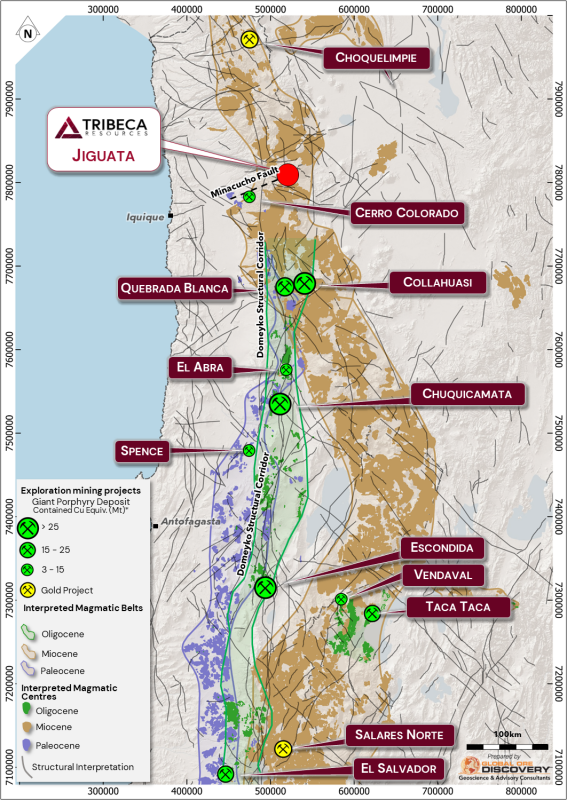
Tribeca Resources reports encouraging technical results from its Jiguata porphyry copper project in Tarapacá, northern Chile (10,000 ha), identifying four alteration centres along a ~7 km x 4 km corridor with coincident IP chargeability, low-resistivity anomalies and discrete magnetic highs interpreted as intrusive centres. Preliminary pXRF soils outline multi-element anomalism (As, Mo, Pb) with historic rock chips up to 1,700 ppm Mo and >200 ppm Cu / 0.03 g/t Au locally; historic RC drilling was limited to 250–300m and considered too shallow. Company plans further mapping, geochemistry and targeted drilling once lab results and integrated surveys refine priority targets, while emphasizing continued field work and permitting/operational uncertainties.
Market structure: The Jiguata update primarily benefits junior copper explorers active in northern Chile (Tribeca Resources - TSXV:TRBC/OTCQB:TRRCF), geophysics/contractors and mid‑tier miners looking to bolt-on discoveries. If drilling validates a porphyry system, majors gain optionality for M&A but supply impact is multi‑year (8–15 years to production), so near‑term copper pricing effect is limited; watch copper at $4.00/lb as a psychological level that would materially lift explorer valuations. Financially stressed juniors without targets stand to be diluted through follow‑on financings; service providers see near term revenue uptick from increased fieldwork.
Risk assessment: Key tail risks are negative drilling results, Chile regulatory changes (royalty/tax proposals) and water/ESG permit denials; each can wipe out >70% of a junior’s market cap. Immediate risks (days–weeks): lab backlog and data revision; short term (months): drill permitting and first holes; long term (12–36 months): drilling success/failure and capital raises. Hidden dependencies include reliance on pXRF preliminary data, non‑unique geophysical signatures (false positives), and limited historic drilling depth; a first drill intercept <0.1% Cu over 20–30m should materially reduce prospectivity.
Trade implications: Direct tactical plays are a small, staged exposure to TRBC (speculative) and increased copper exposure via COPX or FCX with defined trigger/stop thresholds. Use pair trades to express commodity divergence (long COPX vs short GDX) and options (6–12 month call spreads on FCX or COPX if copper >$4.00/lb) to cap downside. Entry: nibble now (1–2% of portfolio) and add only after lab geochemistry within 30–90 days or positive first‑drill assays; exit/trim on failure to meet thresholds or if Chile policy risk intensifies within 60 days.
Contrarian angles: Consensus prizes district‑scale potential, but historical porphyry success rates from geophys+argillic caps are low (<10% to economic deposit). The market may underprice dilution risk from successive financings; conversely, supply concerns are often overstated—even a sizable discovery here would only marginally affect global copper supply for several years. Unintended consequence: a run of similar early‑stage positive releases can flood junior equities with capital, creating short‑term mean reversion risk; price spikes should be faded unless backed by robust drill intercepts (>0.3% Cu over 50m).
AI-powered research, real-time alerts, and portfolio analytics for institutional investors.
Request DemoOverall Sentiment
mildly positive
Sentiment Score
0.28
