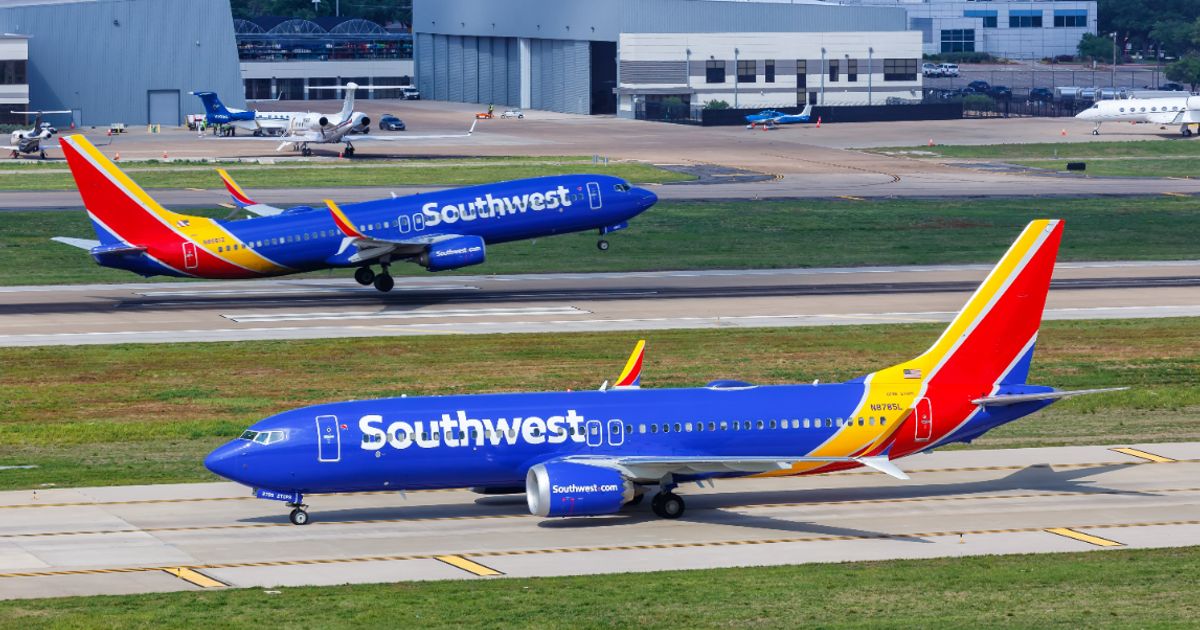
Southwest issued 2026 guidance well above Street expectations, forecasting at least $4.00 EPS versus a $3.19 consensus and more than triple its 2025 adjusted earnings, sending shares up over 6%. The carrier also guided Q1 adjusted EPS of at least $0.45 (consensus $0.33), projected RASM growth of at least 9.5% (consensus 8.5%) and full-year capacity growth of 2–3%. Q4 results were mixed: adjusted EPS $0.58 (+$0.01 vs. consensus) while operating revenue was about $7.4B (vs. $7.5B expected), with record Q4 passenger revenue of $6.8B (+7.6% y/y). Management cited transformation initiatives (bag fees, basic economy, seating, loyalty and distribution changes) and cost controls as drivers of improved outlook.
Market structure: Southwest (LUV) is the direct beneficiary — guidance implies at least ~$4.00 EPS in 2026 vs Street $3.19, signaling meaningful margin expansion from ancillary fees, loyalty optimization and modest capacity growth (2–3%). Competitors face pressure to match fares/ancillaries or cede domestic share; expect unit revenue dispersion across carriers over the next 2–6 quarters as legacy carriers choose between yield defense and capacity retention. Strong RASM guidance (+≥9.5% for Q1) indicates demand is outpacing supply growth domestically, tightening seat inventory into 2026 unless competitors add capacity.
Risk assessment: Key tail risks include severe operational disruption (weather/IT), a fuel shock (jet fuel +20% YoY) that could erase guidance, and regulatory or litigation risk from newly introduced fees; each could swing EPS by >20% vs guidance within months. Immediate risk (days) is IV compression and share re-rating; short-term (weeks–months) depends on Q1 RASM and winter weather; long-term hinges on sustained loyalty and distribution gains being repeatable. Hidden dependencies: much of upside assumes one-time optimization and pricing elasticity holds — reversal in consumer leisure demand or intensified competition would undercut margins.
Trade implications: Direct play: establish a 2–3% long position in LUV equity with a 6–12 month horizon to capture realization of $4 EPS target, trim on +25% price appreciation or downgrade in guidance. Options: use a defined-risk 3–6 month bull-call spread (buy ATM, sell ~+20% strike) to leverage EPS upside while limiting IV crush loss. Pair trade: long LUV vs short JBLU (1:1 notional) for 3–6 months to express ancillary-driven margin divergence. Rotate sector exposure modestly into US domestic leisure carriers and travel-related credit names while trimming exposure to network-heavy, business-travel dependent carriers (AAL, UAL).
Contrarian angles: The market may be underestimating rollback risk — regulators or consumer backlash could force partial reversal of ancillary changes, so momentum is possibly overbought near-term. Historical parallels (ancillary rollouts post-2010) show initial revenue lifts can normalize within 6–12 months as competition adapts; expect reversion risk if competitors quickly match fees. Unintended consequences: higher fares could accelerate booking shifts to ultra-low-cost carriers or stimulate price-sensitive demand destruction if macro softens, so use triggers (see decisions) to limit drawdown.
AI-powered research, real-time alerts, and portfolio analytics for institutional investors.
Request DemoOverall Sentiment
strongly positive
Sentiment Score
0.68
Ticker Sentiment
