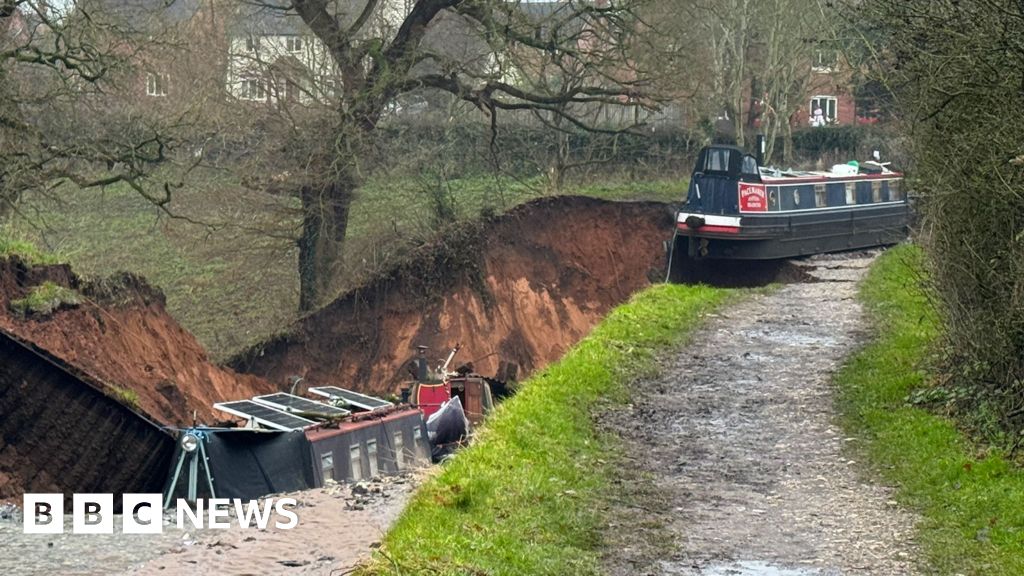
An embankment failure on the Llangollen Canal at Whitchurch, Shropshire caused a large collapse and trenching that released water into adjacent fields, leaving a cavity roughly 45–55m long and about 4m deep. Two narrowboats sank and two more are precariously teetering; up to 15 people were evacuated, 50 firefighters attended and a flood gate was installed to stem further loss of water; Canal & River Trust engineers will recover boats, inspect and rebuild the man-made embankment but gave no timeline for repairs. The incident presents localized infrastructure and property damage risk and temporary navigation disruption, with minimal broader market implications.
Market Structure: The event is a localized shock that creates clear short-term winners — civil-engineering contractors, aggregate/cement suppliers and specialist salvage firms — and losers — local leisure/tourism operators, liveaboard residents and small private insurers on property/flood lines. Expect a concentrated lift in short-term demand for earthworks and materials over a 1–6 month window (orderbook uptick perhaps +5–15% locally), but negligible national demand shock.
Risk Assessment: Tail risks include discovery of systemic embankment weakness across other historic canals triggering a national inspection programme and multi-hundred-million-pound remediation spend (high-impact, low-probability). Immediate risks (days) are operational (salvage, temporary flood gates), short-term (weeks–months) are contract award timing and insurance claims aggregation, long-term (quarters) are regulatory tightening and higher public maintenance budgets.
Trade Implications: Tactical alpha lies in small, event-driven exposure to contractors and materials names ahead of municipal/charity-funded repair contracts, and avoiding/shorting tourism assets that monetize canal traffic for 1–3 months. Options can be used to express asymmetry: short-dated call spreads on contractors to limit downside while capturing upside from contract announcements; buy protection if worried about a broader inspection contagion.
Contrarian Angles: Consensus will treat this as local; the market underprices the probability of a speedy, centrally funded remediation programme that would lift several contractors’ midcap revenues by low-double-digits. Conversely, insurers may be over-penalized on social media-driven fear; if no systemic failures are found within 30–90 days, insurer spreads should tighten and leisure names should mean-revert.
AI-powered research, real-time alerts, and portfolio analytics for institutional investors.
Request DemoOverall Sentiment
mildly negative
Sentiment Score
-0.25
