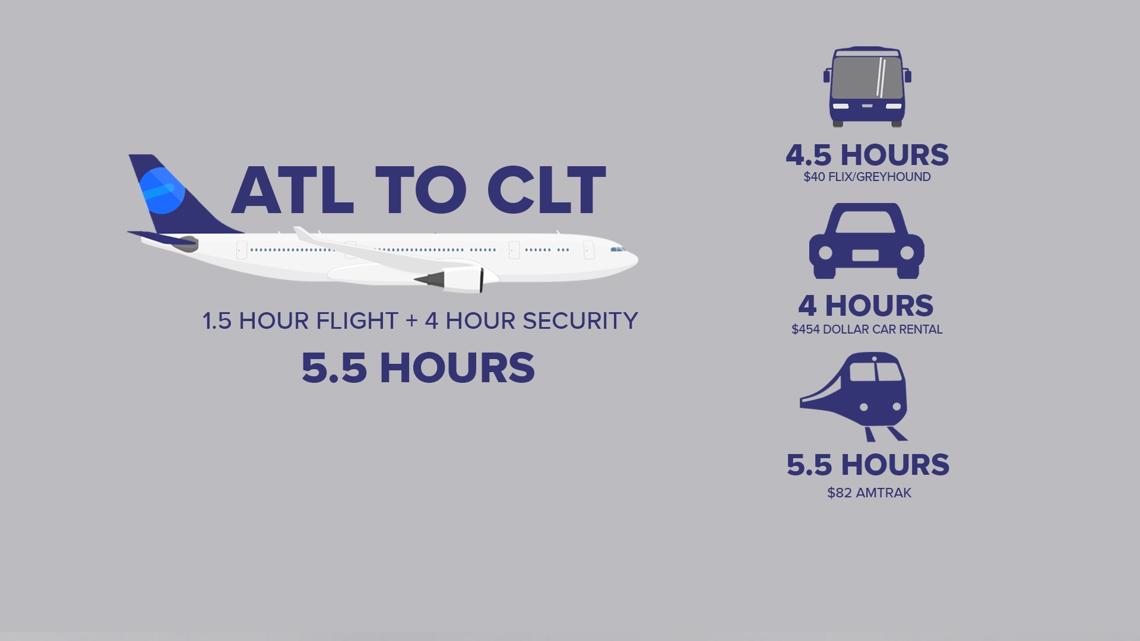
TSA staffing in Atlanta has deteriorated such that travelers are being advised to arrive at least four hours early, with morning-peak waits sometimes longer. That added security time makes many short-haul flights (e.g., 90-minute to Charlotte) and some medium-haul trips (e.g., Cincinnati comparable to a ~7-hour drive door-to-door) slower than driving or taking Amtrak's Crescent route, likely shifting regional travel demand toward ground and rail alternatives.
Atlanta’s screening bottleneck creates a localized modal substitution shock that disproportionately hits hub-dependent carriers and the upstream short‑haul network economics. Delta (largest ATL exposure) will see outsized yield pressure on sub‑500 mile flows because door‑to‑door parity erodes margins on feeder routes and cannibalizes connecting traffic that used to be defensibly time‑sensitive. Ground‑transport capture is concentrated: rental cars, app‑based pickups and intercity operators disproportionately benefit on trips where incremental door‑to‑door time swings 1–3 hours, while airport concession revenue suffers from lower dwell times and more frantic itinerants.
The timeline for material impact is front‑loaded (days–weeks) for bookings and operational disruptions, but could persist for months if hiring, overtime budgets, or process redesigns lag — a politically tractable catalyst (federal relief/staffing surge) could reverse flows within 4–12 weeks. A longer‑run structural change (years) is plausible only if friction becomes persistent enough to shift corporate travel policies away from connecting flights in favor of surface alternatives for certain markets; that would permanently depress regional frequency and spare‑parts demand for regional aircraft. Key monitoring signals: ATL regional yields, rental pricing spreads vs. historical seasonals, and TSA overtime/headcount announcements.
Markets likely underprice the asymmetric exposure of hub carriers versus ground‑service players: short‑haul elasticity is nonlinear — a 10–15% increase in perceived door‑to‑door time can cut booking propensity by a materially higher percent. Trade opportunities that express this convexity should be sized for event risk (staffing fixes) and time‑limited to 1–6 months while monitoring early indicators that the trend reverts.
AI-powered research, real-time alerts, and portfolio analytics for institutional investors.
Request DemoOverall Sentiment
mildly negative
Sentiment Score
-0.30
