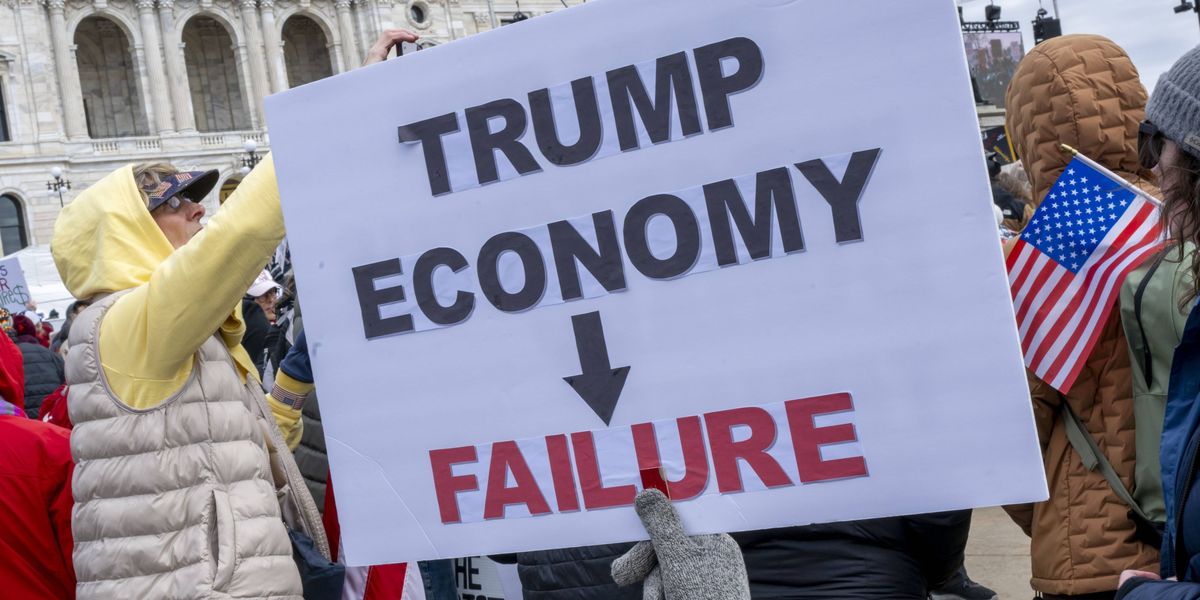
Employers added 178,000 jobs in March and the unemployment rate ticked down to 4.3% (7.2 million unemployed), but analysts flag that average monthly payroll gains over the last two months were only ~22,500 and March’s headline gain largely reversed February declines. Federal employment is down ~352,000 since January 2025 and manufacturing has lost ~82,000 jobs since then; wage growth is slowing and real wages risk deteriorating as inflation and oil prices rise. Geopolitical shocks from the Trump-led war in Iran (estimated $8.4B extra consumer fuel spending in month one) plus Pentagon requests of ≥$200B (and broader $1.5T military ambitions) raise fiscal and energy-price risks that could weaken the labor market further.
The interaction of a geopolitical shock with a fiscal regime that is simultaneously cutting social supports creates a compressed consumer-income shock likely to show up as weakening discretionary demand over the next 1–3 months. Historically, a sustained $10/bbl rise in Brent translates into ~0.2–0.3pp added to headline CPI over 2–3 months; with nominal wage growth slowing, that magnitude of pass-through will push several percentage points of real-income loss for lower-income cohorts and mechanically shave retail and leisure spend.
Defense primes and upstream energy producers are the obvious near-term beneficiaries, but the larger, underpriced lever is federal budget reallocation: even a $200B supplemental drives identifiable multi-year backlog and R&D funding for major primes (a 5–10% revenue uplift for program-heavy names if enacted), while deeper Medicaid/benefit cuts raise uncompensated-care risk for hospitals and tighten state budgets. Expect health providers and lower-end retailers to see margin pressure from unpaid bills and weaker ticket sizes.
Key catalysts and time windows: days–weeks for oil price moves tied to military incidents or tactical announcements (high gamma), 1–3 months for labor-market deterioration to show in consumption and corporate sales, and 6–24 months for enacted defense budget changes to re-rate contractors via backlog recognition. The primary reversal paths are a diplomatic de-escalation or a policy response (SPR release or targeted fiscal relief) which would reflate risk assets and compress energy and defense premia within 30–90 days.
AI-powered research, real-time alerts, and portfolio analytics for institutional investors.
Request DemoOverall Sentiment
strongly negative
Sentiment Score
-0.62
