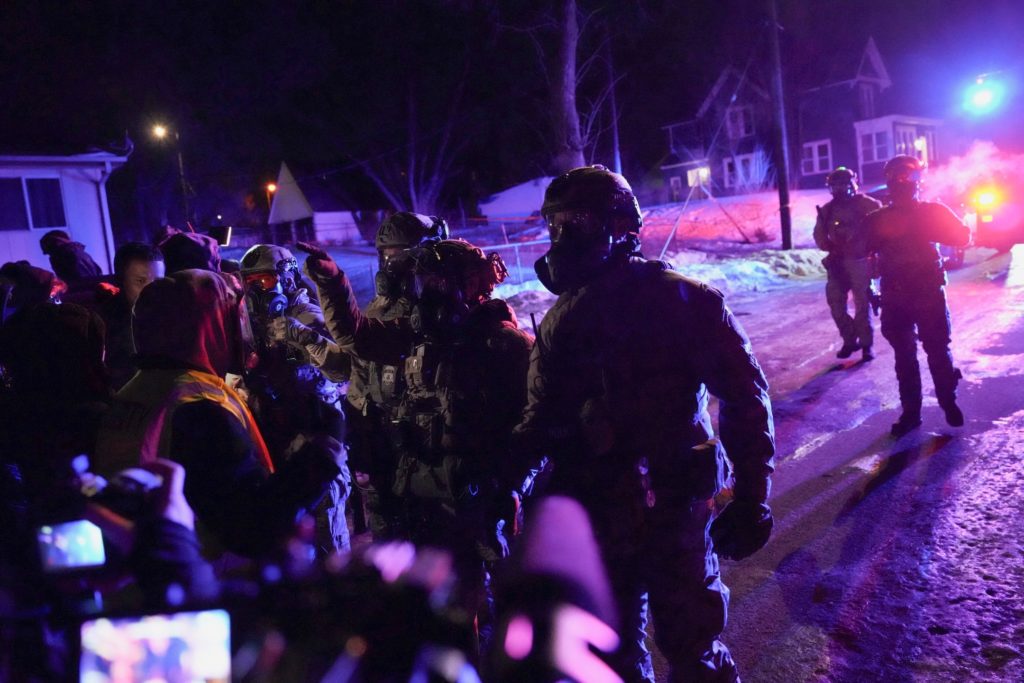
Protests in Minneapolis escalated after clashes between protesters and ICE agents left a man shot and wounded following an alleged assault on federal officers; the city's mayor called for calm as President Trump threatened to deploy troops to the Twin Cities. The unrest and prospect of federal troop deployment increase short‑term political and operational risk in the region, adding uncertainty for local economic activity and any investor exposure tied to Minnesota-specific assets or operations.
Market structure: Localized civil unrest and federal rhetoric lift demand for defense, homeland-security and surveillance suppliers (beneficiaries: LMT, RTX, NOC, LHX, CACI) while increasing operational risk for Minneapolis-headquartered retail (TGT) and downtown-focused REITs. Insurance claims and municipal-credit stress (Minnesota/Hennepin county munis) could widen spreads by 10–30bp if unrest persists beyond a week, pressuring regional banks and short-term funding in the area. Cross-asset: expect a short-lived risk-off push—S&P down ~0.5–1% intraday, 2s10s flattening as Treasuries rally, VIX +10–30% intraday, modest bid for gold and USD; oil likely unaffected unless unrest spreads to logistics hubs.
Risk assessment: Tail risks include federal troop deployment or broader civil disturbance that triggers national supply-chain disruption (low probability, high impact) and a political/regulatory clampdown on private detention providers (GEO, CXW). Time horizons: immediate (1–7 days) = volatility spikes and local revenue hits; short-term (1–3 months) = defense order rhetoric may turn into budget proposals; long-term (6–18 months) = regulatory outcomes and municipal credit reviews. Hidden dependencies: municipal revenue concentration (sales & hospitality taxes), corporate insurance renewals, and retailer foot-traffic recovery; catalysts include presidential statements, state emergency orders, and congressional hearings.
Trade implications: Tactical: establish modest exposure to defense/security and short politically exposed assets. Use defined-risk option structures to limit drawdowns—buy 3–6 month 5–10% OTM call spreads on LHX and LMT sized 1–2% NAV each; initiate 1–1.5% shorts in GEO and CXW equity (or buy puts) for regulatory downside over 3–6 months. Hedging: buy 2-week VIX calls sized to cover 0.5–1% portfolio drawdown and add 0.5–1% TLT for short-term flight-to-quality.
Contrarian angles: Consensus may overpay defense names on headline rhetoric—if no budget follow-through, expect mean reversion within 3 months; private-prison shorts are crowded after prior activism and could rally on any ICE funding increase, so pair long LHX / short GEO (ratio 1:2 by notional) to capture asymmetric risk. Historical parallels: 2020 local unrest hit retail and hospitality for 1–6 months then rebounded—avoid permanent structural bets on single-event disruptions. Monitor municipal bond spreads widening >20bp and Dept. of Defense budget bill language over next 30–90 days as decision triggers.
AI-powered research, real-time alerts, and portfolio analytics for institutional investors.
Request DemoOverall Sentiment
mildly negative
Sentiment Score
-0.25
