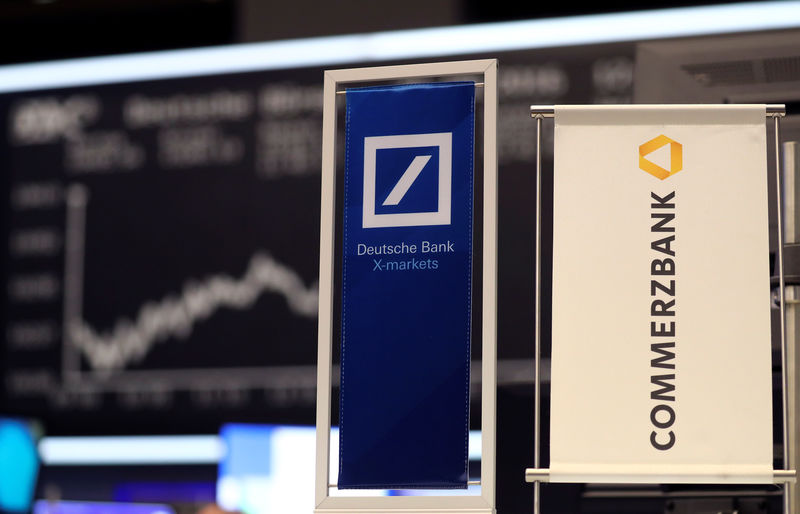
UniCredit escalated its takeover campaign for Commerzbank, calling the German lender "overvalued" and "not future-ready" while arguing its own "Commerzbank Unlocked" plan would lift return on tangible equity above 19% by 2028 versus 15% consensus. UniCredit said Commerzbank’s 2025 results masked a roughly €200 million cost miss, partially offset by a €500 million NII beat, and projected €5.1 billion net profit versus €4.5 billion under the bank’s current plan. The shares moved modestly, with UniCredit down 2.3% and Commerzbank up 0.9% intraday.
This is less about a takeover premium and more about a repricing of execution credibility. UniCredit is effectively forcing the market to choose between a clean standalone rerate story and a balance-sheet-led industrial logic: if Commerzbank cannot convert the current profitability window into durable cost-out and capital returns, the market will stop paying for “optionality” and start discounting stagnation. The immediate winner is UniCredit’s own relative narrative, because the bid pressure creates a floor under the target while leaving open the possibility that the acquirer can buy growth at a discount to its own stock currency. The second-order effect is that German and European bank multiples may become more dispersion-driven over the next 1-2 quarters. Banks with visible cost discipline, fee mix, or excess capital should outperform; institutions with politically constrained restructuring, weak domestic growth, or noisy governance will likely de-rate as investors apply a harsher “self-help or be acquired” screen. This also raises the bar for any other cross-border consolidation in Europe: if Commerzbank can be argued to be worth more only through a merger, then standalone banks with similar capital intensity but weaker franchises become easier short candidates. The key risk is timing. The market can keep re-rating the target into a bid while the acquirer stock underperforms on deal uncertainty, so the spread can widen before it converges. A formal offer is the next hard catalyst, but the real medium-term driver is whether management can defend the standalone plan with verifiable quarterly cost and loan-growth evidence; if not, the bear case compounds over months as governance skepticism turns into multiple compression. Contrarian view: the market may be underestimating how much of the upside is already embedded in the target from takeover speculation, while underappreciating the political and execution discount on the acquirer. If UniCredit’s tender premium ends up being moderate, the relative-value setup could favor shorting the acquirer rather than chasing the target from here, especially if the bid process drags and sentiment shifts from strategic to regulatory noise.
AI-powered research, real-time alerts, and portfolio analytics for institutional investors.
Request DemoOverall Sentiment
mildly negative
Sentiment Score
-0.25
