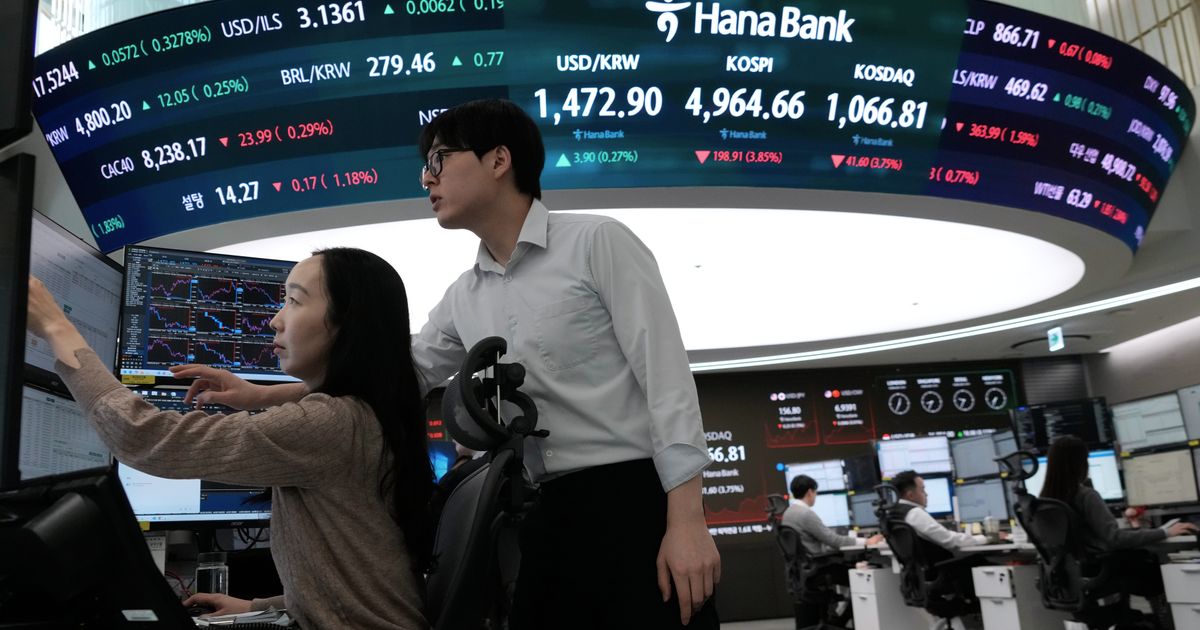
Global equities slid as technology names led a sell-off driven by renewed skepticism about massive AI spending and fresh competitive AI tools, with the S&P 500 down 1.2% at 6,798.40, the Nasdaq at 22,540.59 and futures modestly lower. Notable moves included Qualcomm -8.5%, Amazon down ~11% in after-hours after flagging a $200bn-plus capex increase, Tokyo’s Nikkei +0.5 (54,073.52) while South Korea’s Kospi fell 1.7% (5,076.69) and Hong Kong’s Hang Seng dropped 1.2% (26,569.14). Risk assets weakened alongside crypto—Bitcoin trading just under $65,000 after a ~9% decline—and safe-haven and commodity shifts saw gold at $4,843.70/oz (-1%), silver $71.63/oz (-6.6%), WTI $63.64/bbl and Brent $67.91/bbl; FX moves included USD/JPY 156.74 and EUR/USD $1.1789. The confluence of AI-driven earnings/capex concerns, volatile crypto and commodity moves, and regional political events (Japan election) underscores a cautious, risk-off trading environment.
Market structure: The immediate read is a rotation away from long-duration, high-capex tech beneficiaries toward cash-generative hardware and safe havens; big losers are high-multiple AI spenders (AMZN, large cloud/software names) while select semicap and legacy chip vendors (e.g., Tokyo Electron, SK Hynix) and defensives (gold, Treasuries) get relative support. Pricing power shifts favor firms with positive free cash flow and clear path-to-profitability; market punished capital-intensive guidance (Amazon’s $200B) even though spend is multi-year, implying short-term liquidity/earnings repricing over the next 3–12 months. Supply/demand: weaker risk appetite compresses demand for capital goods temporarily (equipment ordering volatility), but secular AI demand still supports semiconductor equipment backlog over 12–36 months—expect inventory digestion for software vendors in quarters 1–3. Cross-asset: expect lower yields and higher TLT/long-duration bond bid in risk-off; FX to see JPY strength if Japan election surprises; oil modestly insensitive but gold/silver remain volatile and act as liquidity sinks when equities gap down.
Risk assessment: Tail risks include stricter AI regulation or a major AI product failure leading to sector-wide revaluation (-30%+ on marquee software names in 6–12 months) and credit-driven capex pullbacks that hit semicap suppliers. Immediate (days) risk: momentum-driven liquidations; short-term (weeks–months): margin compression from capex and delayed monetization; long-term (quarters–years): structural reallocation to AI hardware if models require persistent compute, benefiting semis. Hidden dependencies: vendor capex timelines, corporate FX hedging, and alternative smaller AI entrants (Anthropic) that can compress incumbent pricing. Catalysts: earnings guidance (next 30–90 days), Amazon/Alphabet spending cadence, chip order books, and VIX crossing 30 would accelerate flows.
Trade implications: Favor calibrated long exposure to high-ROIC semis and equipment (SOXX/TEL equivalents) and tactical short or options protection on large-cap AI spenders (AMZN, high-multiple SaaS). Use pair trades to capture dispersion: long QCOM (fundamentally profitable, beaten-down) vs short AMZN/mega-cap cloud spenders; target mean-reversion over 3–12 months. Options: buy 1–3 month put spreads on AMZN and 3-month 5–10% OTM puts on QQQ as portfolio insurance; buy 6–18 month LEAP calls on select semicap beneficiaries. Sector rotation: reduce hypergrowth SaaS weight by 30–50% of active risk and redeploy to semiconductors, industrial AI suppliers, and short-term Treasury hedges.
Contrarian angles: The consensus conflates capex announcements with immediate profitability hits—AMZN’s $200B is multiyear and could underprice future revenue capture; overreaction could create 20–40% buying opportunity if execution remains intact. Qualcomm’s 8.5% drop despite beat suggests oversell in well-capitalized hardware names—consider buying 6–12 month dip with stop-loss. Historical parallels: 2019–2020 tech drawdowns recovered when earnings cadence resumed; if Q1–Q2 guidance stabilizes, expect sharp mean reversion in selectively punished names. Unintended consequences: aggressive shorting of AI names can slow talent/partner ecosystems, ultimately favoring incumbents with deep pockets—avoid permanent shorts without catalyst-driven timelines.
AI-powered research, real-time alerts, and portfolio analytics for institutional investors.
Request DemoOverall Sentiment
moderately negative
Sentiment Score
-0.60
Ticker Sentiment
