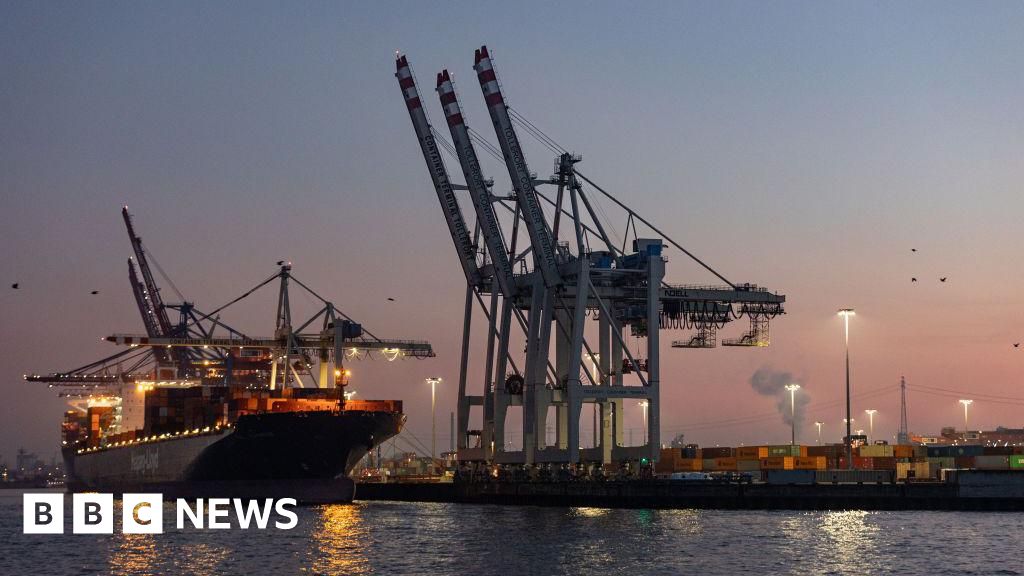
The European Parliament’s international trade committee is set to suspend approval of the US–EU Turnberry trade deal, escalating tensions after US threats of tariffs tied to Greenland and reviving the prospect of retaliatory EU levies on roughly €93bn of US goods; the temporary reprieve on EU tariffs expires 6 February, with levies due to begin 7 February absent a deal. Global equity markets reacted negatively (Dow -1.7%+, S&P500 ~-2%, Nasdaq ~-2.4%) while gold surged above $4,800/oz and silver cooled from a record >$94/oz; the dollar was down about 0.5% overnight. The dispute, combined with a pending US Supreme Court decision on the legality of prior tariffs, raises renewed policy and legal tail risks for cross‑Atlantic trade flows and market positioning.
Market structure: Immediate winners are safe-haven assets and volatility beneficiaries — gold/precious-metals, long-duration Treasuries and exchange operators — while exporters and cyclical European corporates face direct downside because a suspended Turnberry deal and a €93bn retaliation list raise effective trade barriers and input-cost uncertainty. Tariff risk increases US domestic pricing power for sheltered sectors (steel/metal users, some agriculture) and compresses margins for multi-national supply-chain-dependent firms; expect 3–8% directional moves in sector-relative performance over the next 2–8 weeks.
Risk assessment: Tail scenarios include a full US–EU tariff tit‑for‑tat causing a synchronized growth shock (GDP downside of ~0.5–1.5% in the EU over 12 months for hit sectors) or a Supreme Court ruling that re‑legalizes broad tariffs, which would institutionalize higher trade premiums. Near-term catalysts: Strasbourg committee announcement (immediate), EU Feb 7 deadline for retaliation, and the pending US Supreme Court tariff ruling; hidden dependencies include Tier‑1 auto supply chains and metals price pass‑through to margins.
Trade implications: Position for risk-off but keep optionality — overweight physical gold (GLD/IAU) and short-duration rates (TLT) modestly, hedge equity exposure with 3‑month SPX put spreads, and short Europe via VGK or puts to capture asymmetry while keeping small cash-sized allocations to re-enter on policy reversals. Exchange operators (NDAQ) are a tactical long: higher volatility → higher volumes/fee accrual; treat as a 12‑month recovery trade.
Contrarian angles: The market may be overpricing permanence — Brussels can pause and extend the reprieve past Feb 7, and political signaling at Davos suggests negotiation remains likely; that makes deep, event-driven European equity shorts risky beyond the Feb 7 event. Unintended consequence: sustained tariff fear accelerates onshoring and capex in automation/materials — look for selective rebounds in industrial automation and domestic materials names if tariffs linger.
AI-powered research, real-time alerts, and portfolio analytics for institutional investors.
Request DemoOverall Sentiment
strongly negative
Sentiment Score
-0.60
Ticker Sentiment
