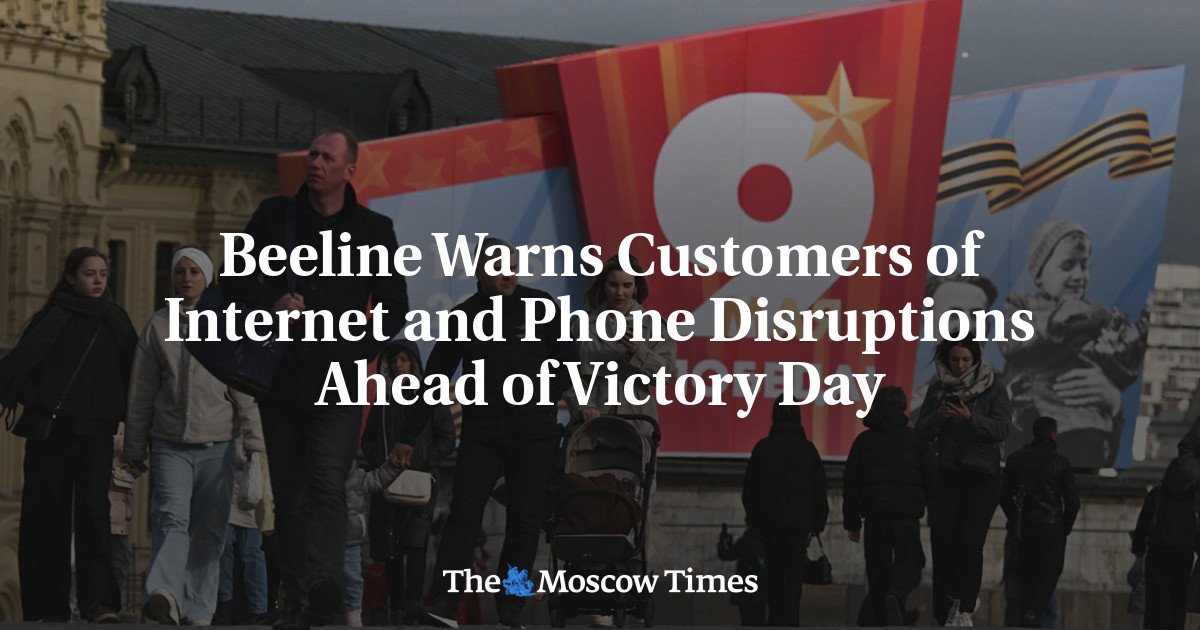
Moscow telecom users are being warned of temporary mobile internet and SMS restrictions from Tuesday to Saturday around the Victory Day parade, with Beeline and Tele2 advising customers to rely on Wi‑Fi and 4G LTE for calls. The Kremlin says the parade is being scaled back due to the risk of Ukrainian drone strikes, underscoring ongoing security-related service disruptions in Russia. The news highlights worsening internet blackouts that have become increasingly common across the country.
The immediate market read-through is not about a single operator’s customer annoyance; it is that state-directed connectivity degradation is becoming a recurring operational control layer in Moscow. That matters because once mobile data is treated as a discretionary security input, every “normal” consumer and SMB workflow that depends on real-time authentication, payments, ride-hailing, delivery, and cloud sync becomes less reliable, which raises friction costs across the local digital economy even if the outages are short-lived. The second-order effect is on trust and substitution. Repeated interruptions push users toward fixed-line/Wi‑Fi and offline payment behavior, which helps larger incumbents with captive infrastructure and hurts asset-light platforms whose unit economics depend on mobile uptime and high-frequency engagement. Over weeks, that can reduce conversion rates and customer retention more than headline traffic loss suggests; over months, it can also accelerate VPN, mesh, and alternative messaging adoption, which ironically increases the state’s incentive to tighten controls further. For tradable exposure, the cleanest implication is a modest negative bias on Russian telecom/service quality proxies, but the bigger opportunity is relative rather than absolute: firms with more resilient enterprise/fixed connectivity should outperform consumer-mobile dependent peers. The risk to the thesis is that these disruptions are usually temporary and event-driven, so the P&L impact may be limited to a few days unless security measures expand beyond the parade window or become normalized across more cities. A reversal would likely require a visible de-escalation in drone threat perception or a political decision to prioritize economic activity over control, neither of which is near-term likely. The contrarian miss is that markets may be underestimating the precedent this sets for “managed network blackouts” as a repeatable policy tool. That can be bullish for cybersecurity and offline-infrastructure vendors over a 6–18 month horizon, because every additional outage increases demand for redundancy, encrypted communications, and non-mobile fallback systems.
AI-powered research, real-time alerts, and portfolio analytics for institutional investors.
Request DemoOverall Sentiment
moderately negative
Sentiment Score
-0.35
Ticker Sentiment
