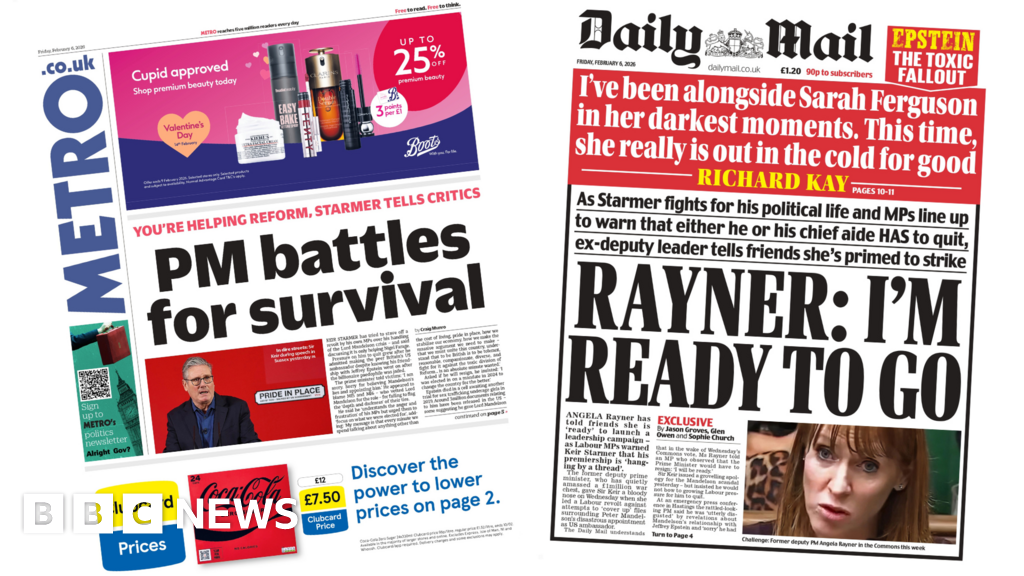
UK Prime Minister Keir Starmer faces a political crisis after appointing Lord Mandelson as ambassador to the US amid revelations Mandelson maintained a friendship with convicted sex offender Jeffrey Epstein; Starmer apologised and is facing growing pressure from Labour MPs and calls for a No 10 reset. Deputy leader Angela Rayner is reported 'ready to go' on a leadership bid while an unresolved tax investigation could complicate her prospects, and ancillary revelations (private jet used for ICE deportations, further Epstein-file disclosures) are intensifying media scrutiny. The episode raises short-term political instability and governance risk for Labour but contains no immediate financial or policy figures likely to move markets materially.
Market structure: Political turbulence around PM Starmer raises idiosyncratic UK risk; direct winners are media/PR firms and legal advisors (short-term revenue boost) while domestic cyclicals—UK housebuilders, regional banks and consumer staples—face demand softness and sentiment hits. Sterling is the primary transmission mechanism (likely 1–3% intraday swings) and FTSE (heavy in domestics) will underperform large-cap global exporters and US equities; Manchester United (MANU) benefits from tabloid attention but is immaterial to macro flows.
Risk assessment: Tail risks include a snap election or confidence vote that could widen 10y gilt spreads by +25–75bp and push GBP -3–6% if markets price policy uncertainty; low-probability/high-impact regulatory fallout (ministerial resignations) could trigger >5% moves in FTSE 100/GBP within days. Immediate window (0–7 days): headline-driven volatility; short-term (weeks–months): repositioning of UK-centric portfolios; long-term (quarters): policy continuity risk affecting corporate capex. Hidden dependency: market reaction hinges more on polling shifts (>3–5% move) than on press cycles alone.
Trade implications: Tactical FX/ rates plays: buy 1‑month GBP puts (strike ~1–2% below spot) or short 10y gilt futures size to target a 25–75bp move; sector trades: initiate 2% portfolio short in UK homebuilders (e.g., PSN.L, TW.L) and 1–2% long in exporters/defensives (e.g., AZN.L, NG.L) as a hedge. Sports/media micro‑play: consider a 1–2% long in MANU (MANU) as a volatility-driven news trade, sized small and stopped at -8%.
Contrarian angle: Consensus may overstate longevity of headline risk—historical UK scandals produced <4% persistent FX/equity moves; if Sterling falls >3% or 10y gilts rise >50bp without political follow‑through, buy beaten-down domestics (housebuilders/banks) for 3–6 month mean reversion. Conversely, a rapid No.10 reset (within 7–14 days) would compress spreads—tighten stop-losses and trim short positions.
AI-powered research, real-time alerts, and portfolio analytics for institutional investors.
Request DemoOverall Sentiment
mildly negative
Sentiment Score
-0.30
Ticker Sentiment
