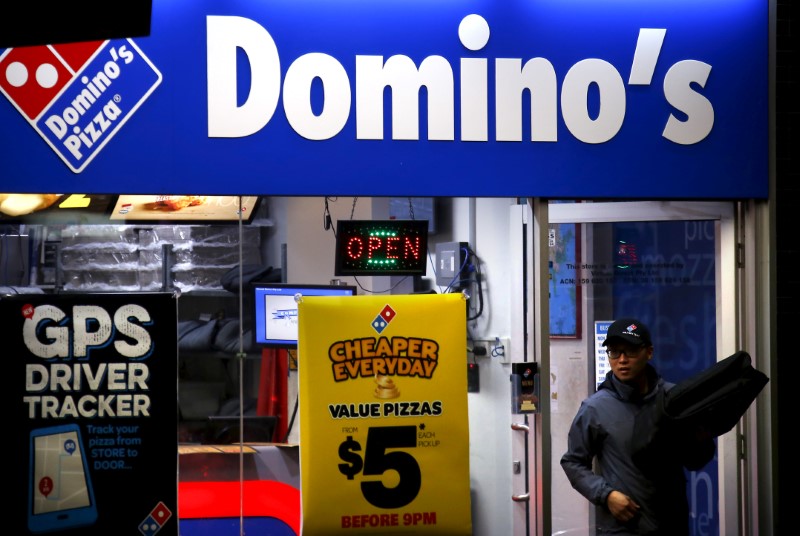
Domino’s Q1 earnings missed expectations, with adjusted EPS of $4.13 versus $4.28 consensus and revenue of $1.15 billion versus $1.17 billion expected. Same-store sales were mixed, with U.S. growth of 0.9% offset by a 0.4% international decline, while total revenue rose 3.5% and operating income increased 9.6% to $230.4 million. The board also approved a new $1.0 billion buyback and declared a $1.99 quarterly dividend, but shares fell 3.8% after the report.
The read-through is less about a one-quarter miss and more about decelerating operating leverage in a business that usually relies on low-single-digit sales growth plus cost discipline to compound. When same-store sales are barely positive, the model becomes much more sensitive to mix, labor, and food inflation; that means small demand slippage can quickly overwhelm franchise royalty growth and make headline EBITDA look sturdier than true underlying cash generation. The market is also likely discounting that the U.S. business can hold share while still failing to reaccelerate ticket growth, which is a warning sign for the broader QSR pizza group. The bigger second-order issue is capital returns funding quality. Buybacks and dividends are still being advertised aggressively, but free cash flow is already rolling over, so the marginal repurchase dollar is increasingly being financed from a narrower cushion. If investment marks tied to the company’s overseas stake remain volatile, reported earnings will stay noisy and make the stock trade more like a quality-growth consumer name than a stable franchise compounder. That can compress the multiple faster than an earnings miss alone would suggest, especially if investors start questioning the durability of incremental store growth internationally. Near term, the catalyst path is asymmetric to the downside: weak traffic commentary, any sign of promotional intensity rising, or another quarter of FCF pressure could trigger a second leg lower over the next 4-8 weeks. The contrarian setup is that management is signaling confidence via buybacks, which may cushion the stock, but that support only matters if the core business stabilizes; otherwise it just delays de-rating. The best bull case is a sharp bounce in order counts without deeper discounting, because that would validate share gains and restore operating leverage into 2H.
AI-powered research, real-time alerts, and portfolio analytics for institutional investors.
Overall Sentiment
mildly negative
Sentiment Score
-0.18
Ticker Sentiment
