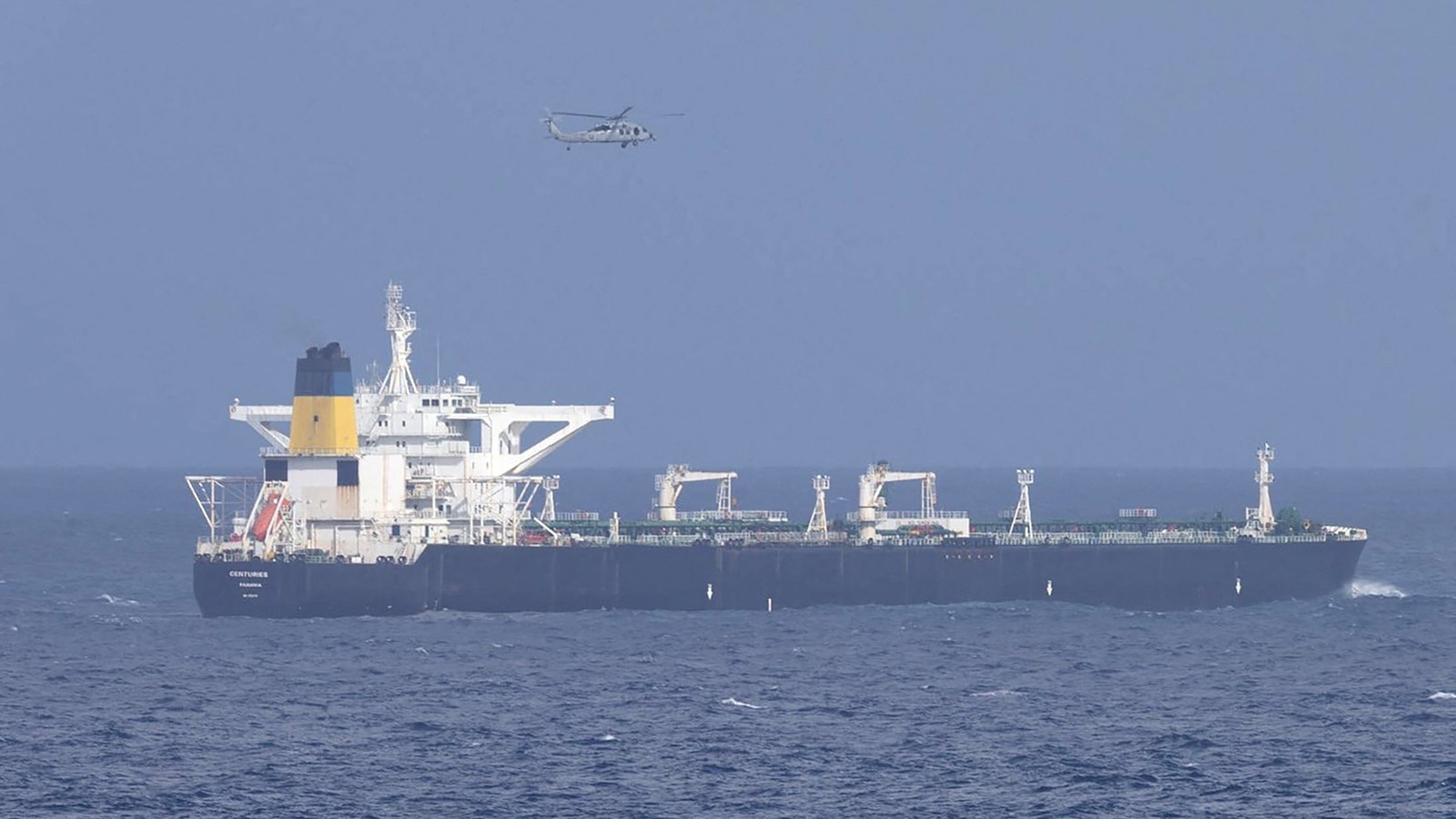
President Trump announced a 'complete blockade' of sanctioned oil tankers to and from Venezuela while U.S. forces — cited as 15,000 troops and 11 warships — are staged nearby; the administration frames interdictions as Coast Guard law-enforcement actions rather than a formal naval blockade. The president's FTO rhetoric (linked by officials to the Cartel de los Soles and allegations against Maduro) creates legal ambiguity and escalation risk as U.S. authorities have already seized tankers; 27 designated vessels were reported in Venezuelan waters. Economically, cutting Venezuelan oil exports could sharply pressure the regime and tighten regional crude flows, but sanctioned tankers represent under ~20% of Venezuela's exports and much of the sanctioned supply serves China, so market disruption is plausible but likely regionally constrained.
Market structure: A narrow U.S. enforcement campaign that targets "sanctioned" tankers is a net positive for integrated, well-capitalized energy majors (e.g., COP, XOM) and refiners that can capture displaced crude flows and premium differentials; defense contractors and maritime insurers also gain from higher demand for security and coverage. If interdictions broaden to all Venezuelan-linked shipments for multiple weeks, expect a 5–15% upward shock to Brent/WTI within 2–8 weeks as buyers scramble for replacement barrels, but if enforcement remains surgical the supply impact should be <5% on global crude given sanctioned tankers represent <20% of Venezuela's exports.
Risk assessment: Tail risks include a naval incident or wider confrontation (low probability, high impact) that could spike oil >20% in days and force global strategic stock releases; another tail is China/Russia orchestrating large-scale substitution via barter/swaps, muting price impact. Short-term (days–weeks) volatility will be highest; medium-term (months) hinges on legal designations (FTO/state sponsor) and insurance market reactions; long-term (quarters+) depends on structural shifts in tanker insurance/premium and rerouting costs.
Trade implications: Tactical trades favor 2–3% long positions in high-quality majors (COP) and 1–2% buys of Brent/WTI call spreads (2-month tenor, targeting 5–15% upside) to capture volatility without full outright exposure; hedge with 1% exposure to defense names (e.g., LMT) or VIX instruments. Avoid or short small-cap tanker equities exposed to opaque ownership (e.g., selective positions in DHT/SFL sized 0.5–1%) where seizure/insurance risk is binary; use tight stops and delta-hedged options to control gamma risk.
Contrarian angles: The market will likely overstate Venezuela's absolute supply role — structural impact may be short-lived as other producers (U.S. Gulf, Brazil, Russia) and floating storage arbitrage refill deficits within 1–3 months. What's underpriced is the insurance/fright-cost shock: higher charter rates and P&I premiums could lift tanker-owner earnings for non-sanctioned vessels while bankrupting shadow operators, creating a bifurcated opportunity in select listed owners; monitor Lloyd’s premium moves and Chinese import/ship-to-ship volumes over next 30 days as early arbitrage signals.
AI-powered research, real-time alerts, and portfolio analytics for institutional investors.
Request DemoOverall Sentiment
moderately negative
Sentiment Score
-0.35
Ticker Sentiment
