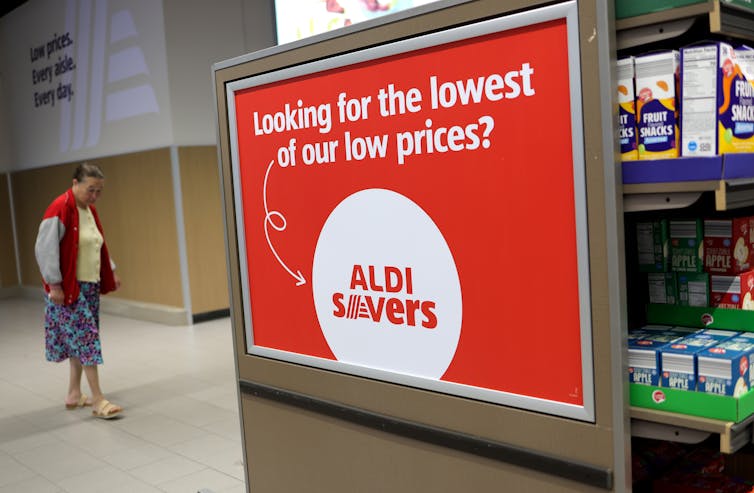
Grocery prices in Colorado have risen roughly 25% over the past five years, outpacing wage growth, amid a highly concentrated market where King Soopers (Kroger) and Walmart control nearly half the share. Aldi announced plans to build 50 stores and a distribution center in Aurora over the next five years (distribution center by 2029), leveraging private-label, low-overhead stores to undercut incumbents; nationally Aldi holds ~3% market share versus Walmart ~21% and Kroger ~9%. The move could strengthen local supply-chain infrastructure, intensify competition, and pressure traditional supermarkets and regional independents in Colorado, with modest implications for regional retail margins and market share dynamics.
Market structure: Aldi’s entry is a regional disruptor, not a national shock — 50 stores vs ~1,000 CO outlets — but it changes pricing dynamics in concentrated corridors where KR (King Soopers) + WMT already control ~50% share. Expect localized price pressure that can compress traditional grocers’ gross margins by an estimated 50–200 bps in affected trade areas over 12–24 months, while Walmart (WMT) is best positioned to defend volume via scale and existing DC capacity. Aldi’s private-label + small-store model favors lower opex per store and amplifies share gains in price-sensitive demographics (rural pockets, food deserts).
Risk assessment: Tail risks include a regional price war that forces nationwide margin concessions (low-probability, high-impact), DC construction delays (Aurora DC by 2029 is a key execution hinge), or Kroger strategic countermeasures (deep promo or accelerated CapEx). Time buckets: immediate (0–3 months) — monitor planning/permits and Colo. permitting headlines; short (3–12 months) — first store openings and basket-price data; long (12–36+ months) — measurable market-share shifts and supplier re-contracting. Hidden dependency: Aldi’s leverage on private-label suppliers and 3PL capacity in Mountain West — shortages here blunt impact.
Trade implications: Tactical stance — go long WMT (scale 2–3% NAV) via 12–18 month LEAP calls to capture 5–12% upside from share gains in Mountain West; establish a 1–2% short in KR equity or buy 6–12 month puts to express margin risk. Pair trade: long WMT / short KR equal notional, rebalance quarterly; set stop-losses at 8–12% and profit-take at 15–20%. Underweight DLTR and modestly reduce COST exposure (membership moat) by 1–2% given limited overlap with Aldi’s customer mix.
Contrarian angles: Consensus understates distribution-center network effects — a single Aurora DC materially increases Aldi’s regional leverage over 24–36 months, benefiting industrial REITs (PLD) and 3PLs. Conversely, impact may be underdone: 50 stores can be rapidly imitated by Kroger price cuts, so KR could be oversold; watch Colorado food CPI and basket-level price moves: if regional grocery inflation falls >2–3% yoy within 12 months, accelerate shorts on traditional grocers.
AI-powered research, real-time alerts, and portfolio analytics for institutional investors.
Request DemoOverall Sentiment
mildly positive
Sentiment Score
0.28
Ticker Sentiment
