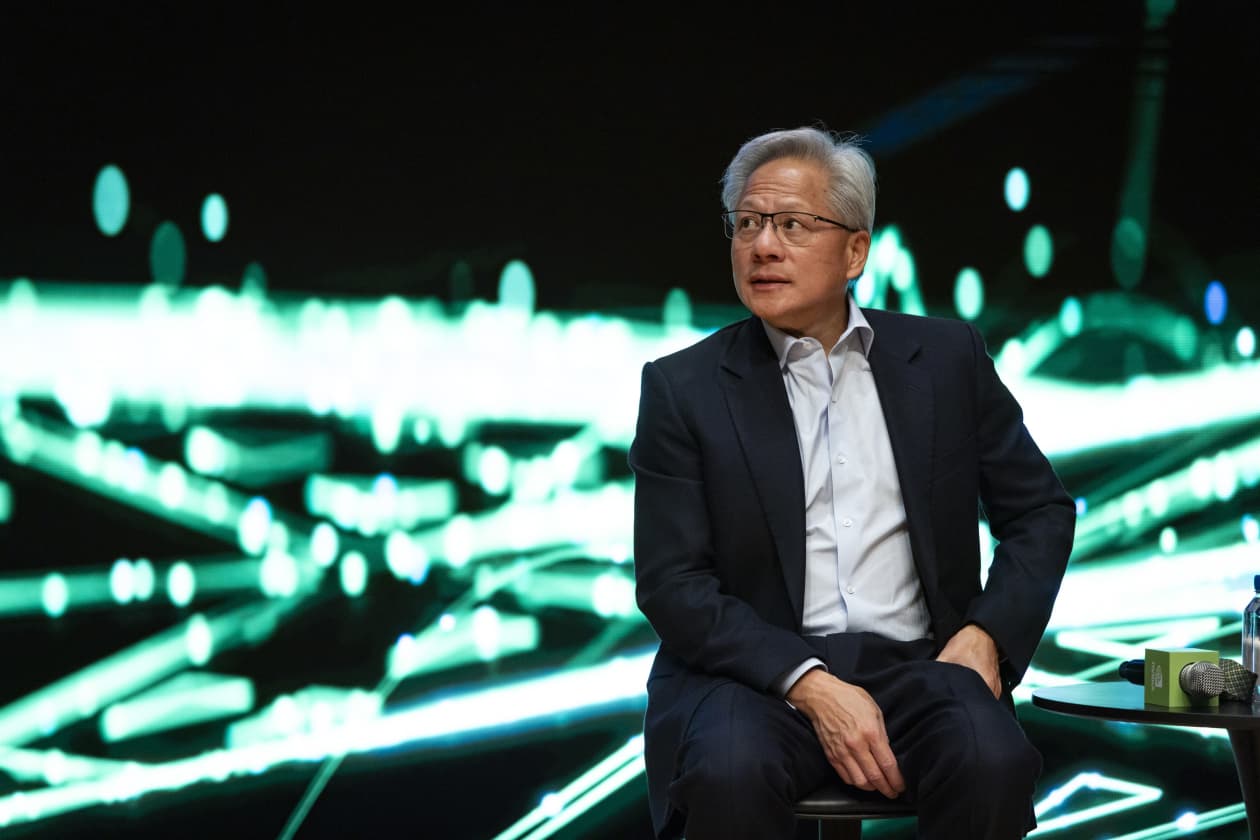
Nvidia will report quarterly results Wednesday with investors focused less on the numbers and more on management’s forward guidance — particularly visibility into 2027 — after CEO Jensen Huang’s projection that Blackwell and Rubin could generate up to $500 billion through next year; Street expectations are about $54.8 billion revenue and $1.25 adjusted EPS for the fiscal third quarter and roughly $62 billion for fiscal Q4. Several analysts (Cantor Fitzgerald, Jefferies, D.A. Davidson) expect Nvidia to reaffirm strong, multi-year AI compute demand and resume a beat-and-raise cadence — Cantor projects $350–400 billion in data-center revenue next year and $450–500 billion in 2027 — which could reignite the AI trade. However, concerns persist around the sustainability and financing of AI capex and whether Nvidia will provide the longer-term order/backlog detail from hyperscalers and sovereigns needed to fully reassure investors and drive further share gains (shares are about 10% below their late-October peak).
Nvidia's upcoming quarterly report is being treated as the quarter's marquee event because investors are focused more on forward visibility than the immediate numbers: FactSet consensus expects $54.8 billion in revenue and $1.25 adjusted EPS for the October quarter and roughly $62 billion for fiscal Q4. Management's prior projection that Blackwell and Rubin could generate up to $500 billion through next year raises expectations for commentary extending into 2027, and the stock is already trading about 10% below its late-October peak, tempering upside from the run-up.
Several sell-side analysts (Cantor Fitzgerald, Jefferies, D.A. Davidson) expect Nvidia to reaffirm robust, multi-year AI compute demand, with Cantor citing a $350–$400 billion data-center revenue range next year and $450–$500 billion in 2027; the thesis rests on continued orders from hyperscalers, sovereigns and frontier AI labs and the ongoing token-generation inflection. Jefferies anticipates a return to a beat-and-raise cadence after a prior quarter whose beat magnitude disappointed investors.
Material risks center on the sustainability and funding of AI capex and the interconnected financing behavior in the ecosystem, including startups taking on debt to buy Nvidia chips, which some analysts view as an overheating signal. Nvidia can materially change sentiment only by providing clearer multi-period order/backlog disclosure similar to catalysts that helped AMD and Broadcom; absent that detail, the market may price in uncertainty despite strong demand indicators.
AI-powered research, real-time alerts, and portfolio analytics for institutional investors.
Request DemoOverall Sentiment
mildly positive
Sentiment Score
0.35
Ticker Sentiment
