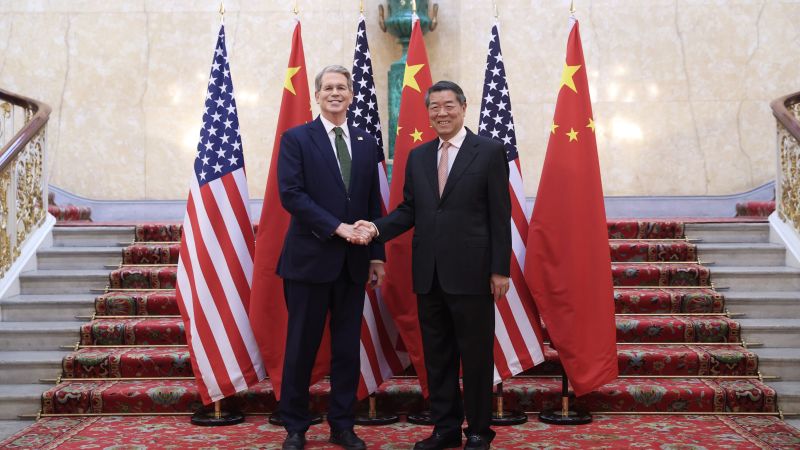
The US and China have reportedly reached a trade agreement framework, aiming to implement a consensus from May and de-escalate trade tensions after a period of heightened restrictions. While this agreement is expected to provide some relief to businesses and investors, current tariff rates remain historically high, and significant export restrictions persist, indicating a return to a tense status quo rather than a complete resolution. Despite the potential for preventing severe trade war consequences, fundamental economic standoffs remain, including concerns over intellectual property and trade imbalances, with the US maintaining substantial tariffs on Chinese goods.
The United States and China have reportedly reached a framework for a trade agreement, ostensibly to implement the consensus reached in May and de-escalate recent severe trade frictions. This development is anticipated to offer some respite from the acute anxiety caused by burdensome tariffs, potentially lowering costs and injecting a degree of certainty into an economy showing signs of strain. However, this truce largely signifies a reversion to the pre-April 2 tense status quo, rather than a fundamental resolution; tariff rates from both nations remain historically elevated, and significant export restrictions persist, including on China's autos to the US and US high-end AI chips to China. The situation had previously deteriorated significantly after President Trump's April 2 "Liberation Day" announcements, which led to a 145% tariff on most Chinese imports, effectively halting trade. While a May 12 agreement saw a rollback of these tariffs, subsequent accusations of unmet obligations, particularly regarding China's slow resumption of rare-earth material exports critical for various industries, led to renewed tensions and US export restrictions. The current agreement, if upheld, aims to prevent dire outcomes such as pandemic-level shortages. Nevertheless, the underlying economic standoff persists, with the US maintaining a 10% universal tariff, an additional 20% tariff on many Chinese goods, and the elimination of the de minimis exemption, impacting e-commerce giants like Shein and Temu. Even companies with diversified supply chains, such as Apple (AAPL), anticipate substantial cost increases, with Apple citing a potential $900 million quarterly impact at current tariff levels, underscoring the continued financial burden despite the purported truce.
AI-powered research, real-time alerts, and portfolio analytics for institutional investors.
Request DemoOverall Sentiment
moderately negative
Sentiment Score
-0.35
Ticker Sentiment
