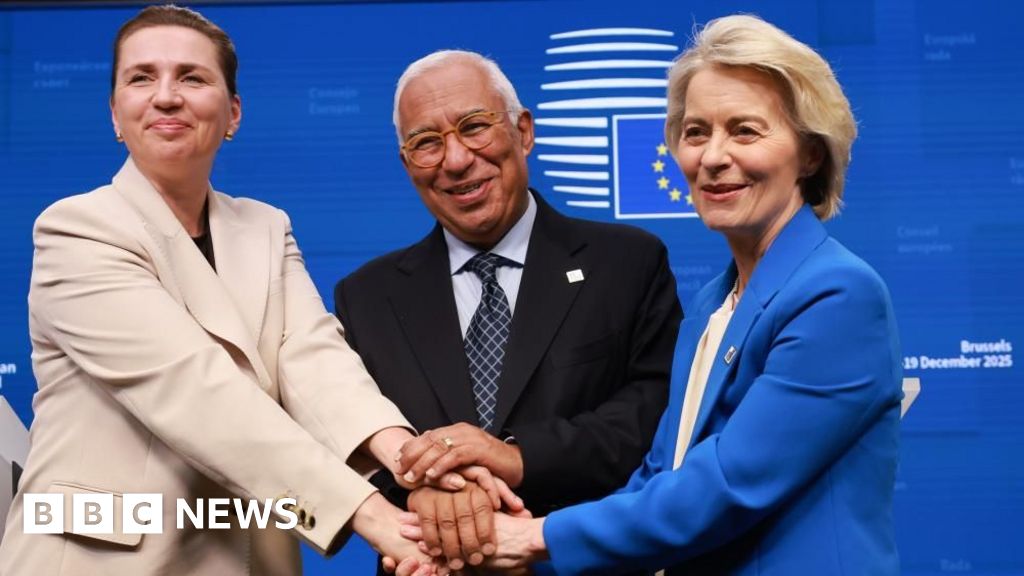
EU leaders agreed to provide Ukraine a €90bn loan backed by the bloc's common budget after failing to authorize use of frozen Russian assets; the package is intended to meet Ukraine's military and economic needs for the next two years. Kyiv has warned it will run out of cash by spring and needs roughly €135bn over two years, making the loan a critical liquidity lifeline while political disagreement over €200bn of frozen Russian funds and ongoing diplomacy (including US-Russia and US-Ukraine talks) leave strategic uncertainty.
Market structure: EU agreement to back a €90bn loan via joint borrowing is a de‑risk for Ukraine but increases sovereign‑level bond supply and transfers contingent liability to the EU budget. Immediate winners are defense and defense‑adjacent suppliers (sustained procurement cycle for 12–24 months) and commodity exporters (energy, metals) who benefit from prolonged conflict-driven demand; losers are holders of frozen Russian assets (legal uncertainty) and short‑duration Euro core bonds that will face 5–25bp of incremental supply pressure over 3–12 months.
Risk assessment: Tail risks include a punitive Russian economic response (energy cutoffs or asymmetric attacks) and legal/credit shocks from attempted use of frozen assets; either could widen EM/credit spreads by 150–400bp in 1–3 months. Hidden dependencies: US guarantees and Miami peace talks are binary catalysts in the next 2–8 weeks that could swing risk premia; EU political fragmentation over liability sharing could resurface as a 6–12 month fiscal drag.
Trade implications: Favor 6–18 month directional exposure to defense (US names/ETF) and integrated energy majors while hedging duration and FX; expect bund yields to grind +5–20bp and EUR to underperform vs USD if issuance accelerates. Use options to asymmetrically express views (debit spreads on XOM/XLE, long calls on RTX/LMT with 6–12 month expiries) and fund positions with short 1–3 month EURUSD forward sells triggered by a >10bp move higher in 10‑yr German yields.
Contrarian angles: The market understates the legal friction from forcing frozen‑asset use — meaning consensus “solution” may revert, creating a volatility spike that depresses cyclicals; conversely, if US guarantees materialize within 4–8 weeks the defense/commodity trades could be overbought and partial profit taking (+20–30%) should be executed. Historical analog: post‑2008 joint EU debt issuance tightened peripheral spreads only after clear legal frameworks — don’t pay up before clarity.
AI-powered research, real-time alerts, and portfolio analytics for institutional investors.
Request DemoOverall Sentiment
mildly positive
Sentiment Score
0.25
