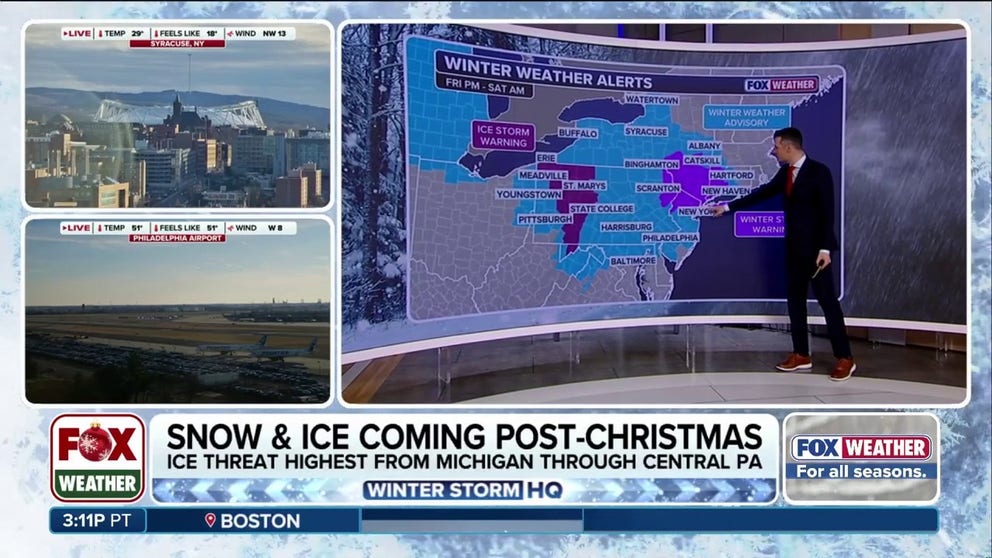
A fast but potent post-Christmas snow and ice storm is forecast to impact more than 60 million people across the Northeast, with the FOX Forecast Center calling for widespread 3–5 inches of snow and locally 5–8+ inches in New York City, northern New Jersey and western Long Island, and snowfall rates up to an inch per hour. National Weather Service warnings include Winter Storm and Ice Storm Warnings, with 0.1–0.25+ inches of ice possible across parts of Pennsylvania and central Michigan that could cause power outages; major hubs including LaGuardia, JFK, Newark and Philadelphia airports and key interstates (I-95, I-94, I-90, I-80, I-91) are expected to see hazardous conditions and travel disruptions. Hedge funds should monitor potential near-term operational impacts to airlines, airport services, freight and regional utilities and the attendant short-term dislocations in travel, logistics and local economic activity.
Market structure: Winners in a 48–72 hour window are utilities and heating fuels (Henry Hub/NG, UNG, heating oil HO) and local snow/road services; losers are passenger airlines (AAL, DAL, UAL, LUV), airport services and short-haul road carriers (UPS, FDX) via missed flights/ground delays. Expect pricing power to shift transiently: spot natural gas and power forwards bid up 5–15% intraday; airline short-dated IV to spike 20–50% on weekly options. Cross-asset: modest bid for Treasuries and USD into the event; energy and power forwards show the clearest direct demand signal.
Risk assessment: Immediate (0–7 days) risk is operational—> flight cancellations and >0.25" ice causing localized outages; short-term (2–12 weeks) risk is claims for insurers and capex push for utilities if outages are sizable; long-term impact is negligible barring a catastrophic grid failure. Tail scenarios: >250k customers out for multiple days would trigger regulatory scrutiny, payout shocks to P/C insurers (PGR, ALL) and forced capex for TOs — low probability (<5%) but high impact. Key catalysts: measured ice accretion >0.25" and airport cancellation rates >10%.
Trade implications: Direct short-duration trades: buy weekly puts on AAL and DAL (1–2 week expiries) sized to 0.5–1% NAV each; go 0.5–1% long UNG or short-dated NG call spreads for a 1–4 week heating demand play. Sector rotation: overweight XLU or NEE (1–2% tactical) for resilience and potential rerating if outages occur. Options strategy: sell put spreads to collect premium where IV inflates, e.g., short 2–3% OTM put spreads on large-cap airlines after IV peaks; set strict 20–30% loss limits.
Contrarian angles: The market often overreacts intraday to travel headlines — historical post-Christmas Northeast storms (2018–2021) show airline equities mean-reverted within 7–14 trading days by ~6–12%. If cancellation metrics stay <5% and ice <0.1", short-dated airline put IV will collapse — convert shorts to longs or close into that squeeze. Unintended consequence: a quick cold snap can spike NG then unwind; size gas exposure accordingly and trim on a 10–15% rally.
AI-powered research, real-time alerts, and portfolio analytics for institutional investors.
Request DemoOverall Sentiment
mildly negative
Sentiment Score
-0.25
