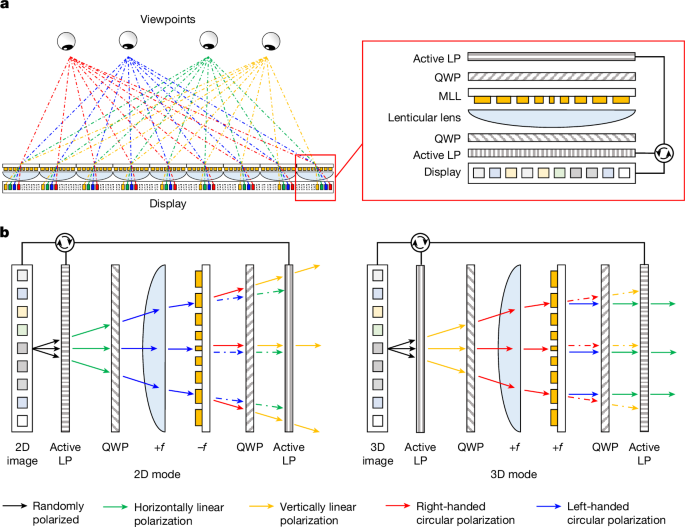
Researchers introduced a full-colour 2D–3D switchable light-field display using a metasurface lenticular lens, highlighting a 100° field of view in an ultrathin 1.2 mm profile. The device was fabricated at a 25 cm2 active area and demonstrated clear 2D/3D switching when mounted on an OLED panel. The work is a promising display-technology advance, but near-term market impact appears limited to the commercialization pipeline.
This is not a display-capex catalyst in the near term; it is an IP and manufacturing-enablement signal that matters if it lowers the cost/complexity of switchable optics enough for mass-market AR/VR, automotive HUDs, and premium handsets. The second-order winner is likely the optics supply chain around high-index materials, nanoimprint/roll-to-roll tooling, and polarization-control components rather than the panel makers themselves. If the approach scales, it raises the odds that 2D/3D switching becomes a feature-level differentiator, which can defend ASPs in a hardware market where pixel density alone is becoming commoditized.
The key commercial implication is that “ultrathin + wide FOV + active switching” attacks the main objections to glasses-free 3D: bulk, limited viewing angle, and poor user flexibility. That should pressure incumbents relying on parallax barriers and liquid-crystal lens arrays, because the new architecture is more compatible with modern OLED form factors and may be easier to package into consumer devices. The likely adoption curve is months-to-years, not days, but once one flagship OEM ships it, the competitive response can be surprisingly fast because this is a visible feature that is easy to market and hard to unsee.
The contrarian risk is that engineering demo success often overstates commercial readiness: efficiency, yield, polarization stability, and cost per square centimeter are the real gating items. If conversion losses or color nonuniformity remain material, OEMs will treat it as a niche premium add-on rather than a platform shift. In that case, the market is likely to overprice the narrative before unit economics are proven, then fade it when first-gen products disappoint on brightness or battery life.
AI-powered research, real-time alerts, and portfolio analytics for institutional investors.
Request TrialOverall Sentiment
mildly positive
Sentiment Score
0.35
Ticker Sentiment
