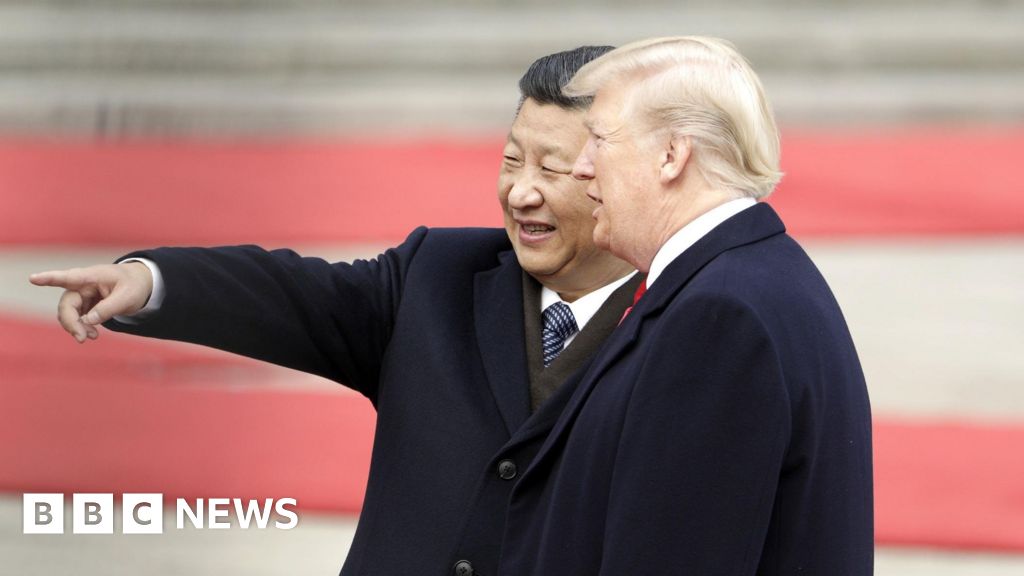
Trump’s return to Beijing comes against a backdrop of a much stronger, more assertive China, with tensions centered on Iran, tariffs, technology, Taiwan and trade. The article highlights Beijing’s push into AI, robotics, renewables and EVs, including plans for roughly $400bn of robotics investment this year, while China’s exports to the US are down about 20% in recent years and the US is now its third-largest trade partner. Market focus is on whether the summit yields a trade truce, increased Chinese purchases of US goods, or further escalation in tech and geopolitical rivalry.
The market implication is not “China stronger,” but “China less dependent on Western chokepoints.” That shifts bargaining power away from broad trade exposure and toward the narrow set of inputs Beijing still cannot efficiently localize: leading-edge AI compute, EDA/software, and some industrial tooling. The most important second-order effect is that any negotiated easing on chips would likely be selective and temporary, which caps upside for full-stack semiconductor bulls while preserving demand for mature-node equipment and China-exposed analog/industrial names. NVDA is the clearest single-name read-through, but the risk/reward is asymmetric in both directions. If export controls stay loose, China demand can support a floor for data-center revenue; if the summit produces even a modest tightening tied to geopolitics or Iran, the multiple de-rates quickly because investors are still pricing a large China option value. Over a 1-3 month horizon, policy headlines can dominate fundamentals; over 12-24 months, domestic Chinese silicon substitution remains the bigger structural drag on NVDA’s China mix. The more interesting trade is in the ecosystem around China’s self-reliance push. Robotics, EVs, renewables, and logistics all benefit from capex prioritization, but that support is uneven and debt-financed, so the winners are likely platform leaders with pricing power rather than the broad industrial complex. In contrast, China’s property- and debt-heavy local governments are effectively underwriting this industrial transformation, which increases the tail risk of funding stress if growth disappoints or exports weaken further. Consensus is too focused on whether a deal is signed and not enough on whether either side can actually enforce one. The fragile truce itself is the signal: Beijing has already diversified enough that it can absorb incremental tariff pressure, while Washington is still constrained by inflation and industrial policy tradeoffs. That makes the next catalyst less about an immediate grand bargain and more about a series of tactical concessions that keep volatility elevated and make pair trades more attractive than outright directional bets.
AI-powered research, real-time alerts, and portfolio analytics for institutional investors.
Request DemoOverall Sentiment
neutral
Sentiment Score
0.05
Ticker Sentiment
