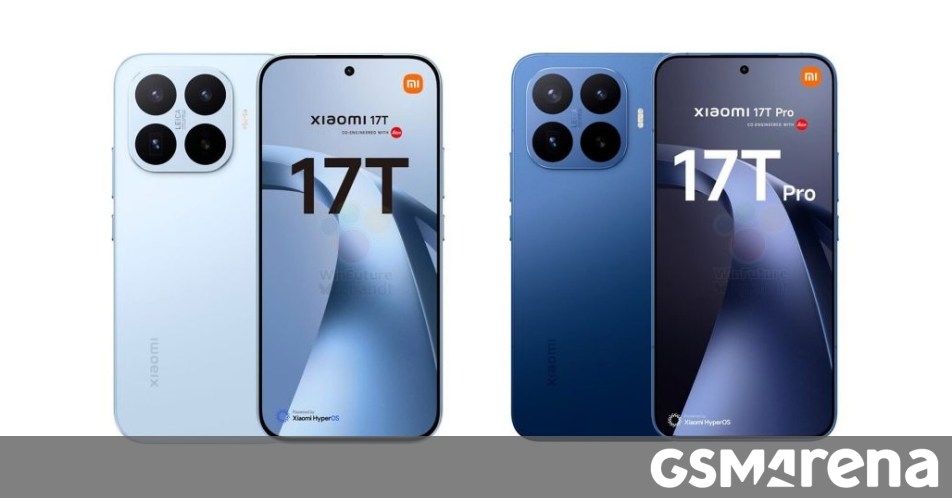
Xiaomi’s 17T series is now reported with full specs and pricing: the 17T starts at €749 for 12GB/256GB, while the 17T Pro is priced at €999 for 12GB/512GB. The 17T features a 6.59-inch 120Hz AMOLED, Dimensity 8500-Ultra, 6,500mAh battery and 67W charging; the Pro adds a 6.83-inch 144Hz OLED, Dimensity 9500, 7,000mAh battery, and 100W wired plus 50W wireless charging. The article is primarily a product preview with no evidence of near-term financial impact.
This is less a handset launch than a margin-management exercise: Xiaomi appears to be leaning on a clear premiumization ladder to keep ASPs rising while preserving a wide enough ladder between “good” and “best” to upsell storage, charging, and display tiers. The real second-order issue is not whether these devices sell, but whether the mix shift can offset the structurally higher bill of materials from larger batteries, faster memory, and more advanced camera modules without forcing promotional pricing in Europe. The competitive read-through is most important for mid-to-high-end Android peers. A €749 starting price for the base model puts pressure on value-premium players that rely on camera parity and charging speed as differentiators, while the Pro tier is positioned to test whether consumers will pay Apple-like prices for a non-Apple brand in a market where channel financing and carrier subsidies are weaker than in China. If Xiaomi wins share here, the spillover is likely felt first by similarly priced Android OEMs and, one layer down, by component suppliers exposed to generic Android inventory cycles. The key risk is that Europe absorbs only a portion of the price uplift, with channel inventory building if demand elasticity is worse than expected; that would show up within one to two quarters via discounting, not immediately at launch. Conversely, the upside catalyst is software support length and AI-feature positioning, which can justify a higher selling price if Xiaomi uses this launch to improve attach rates and ecosystem stickiness rather than just unit volume. Over 6-12 months, the market will care less about launch buzz than whether the premium tier improves gross margin per device and lowers promotional intensity versus prior generations. The contrarian angle is that the market may be underestimating how hard it is for non-Samsung Android vendors to push above the €900 psychological threshold outside China; if consumer uptake is soft, the launch can still be financially neutral because it validates the premium story without forcing a full-scale volume fight. The more bearish version is that Xiaomi is being pulled into a spec arms race just as component costs rise, which would compress returns on incremental R&D and marketing spend.
AI-powered research, real-time alerts, and portfolio analytics for institutional investors.
Request DemoOverall Sentiment
neutral
Sentiment Score
0.10
