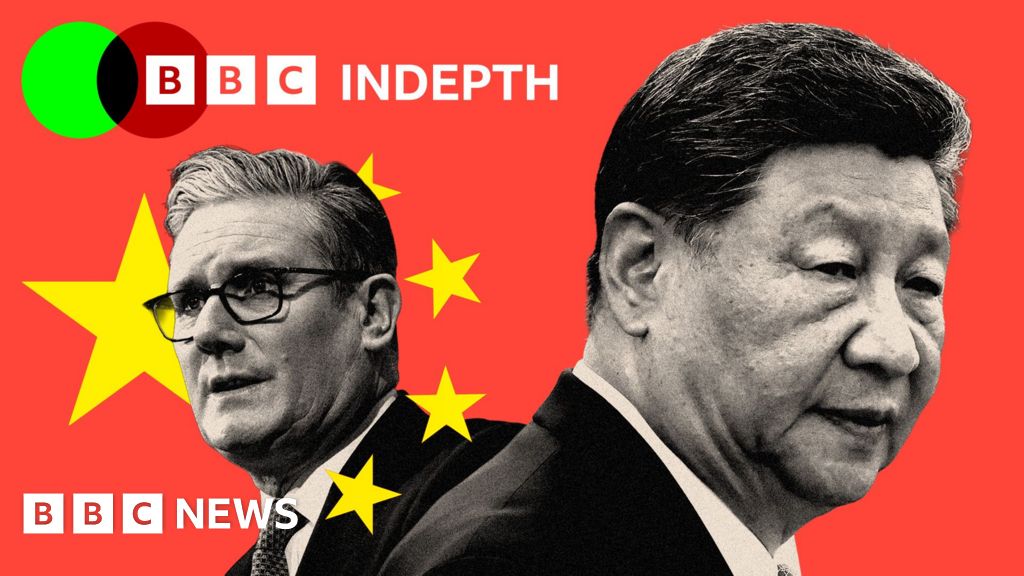
UK prime minister Keir Starmer is making the first UK visit to Beijing in eight years amid a broader Chinese diplomatic charm offensive; the trip follows London’s approval of plans for a Chinese mega-embassy and could underpin dozens of commercial deals. The UK exports roughly £45bn to China while Beijing now produces about one-third of global goods, processes >90% of rare earths and supplies 60–80% of solar panels, wind turbines and EVs, giving it significant leverage; however security concerns, US-China tensions and UK domestic political fragility mean any rapprochement is likely a cautious, slow thaw rather than a full restoration of the previous “golden era.”
Market structure: A modest UK-China diplomatic thaw lifts demand for UK exporters, travel & tourism and Chinese-built clean‑energy hardware destined for the UK. China retains chokehold on rare earths and solar/EV component supply (60–90% share cited), so Chinese exporters gain pricing power while non-China upstream suppliers face margin pressure. FX and fixed income will respond: a confirmed trade/MOU tranche should lift GBP by ~2–4% vs major peers within 3–6 months and compress gilt risk premia; rare‑earth and solar commodity risk premia would fall.
Risk assessment: Tail risks include US secondary tariffs on UK partners (low probability, high impact) or Beijing reversing market access as political leverage (fast shock). Immediate (days) volatility around visit statements; short term (weeks–months) for MOUs and investment announcements; long term (quarters–years) for supply‑chain shifts. Hidden dependency: UK domestic security reviews (telecoms, IP rules) can nullify deals quickly — watch legal restrictions and parliamentary votes.
Trade implications: Favor long UK cyclical/consumer exposure and selective Chinese industrial exporters if MOUs include procurement/visa/energy deals; hedge politically sensitive supply‑chain exposures (rare earths, high‑tech inputs). Use pairs to isolate geopolitical beta (long UK real economy vs short China internet) and options (buy-call spreads on ETFs; buy-put spreads on non-China critical‑mineral names) to limit downside. Entry near announcement windows; hold 3–12 months unless catalyst reverses.
Contrarian angles: Consensus overstates quick “pivot” from US — expect incremental deal flow, not strategic alignment; market may underprice sustained political backlash in UK (populist/sovereignty responses). Mispricing: investors may overpay for a China‑tech rebound; conversely, underpriced insurance exists in non‑China rare‑earth producers for a renewed decoupling. Historical parallel: 2015 thaw→2016–21 freeze warns of reversals once politics change.
AI-powered research, real-time alerts, and portfolio analytics for institutional investors.
Request DemoOverall Sentiment
mixed
Sentiment Score
0.08
