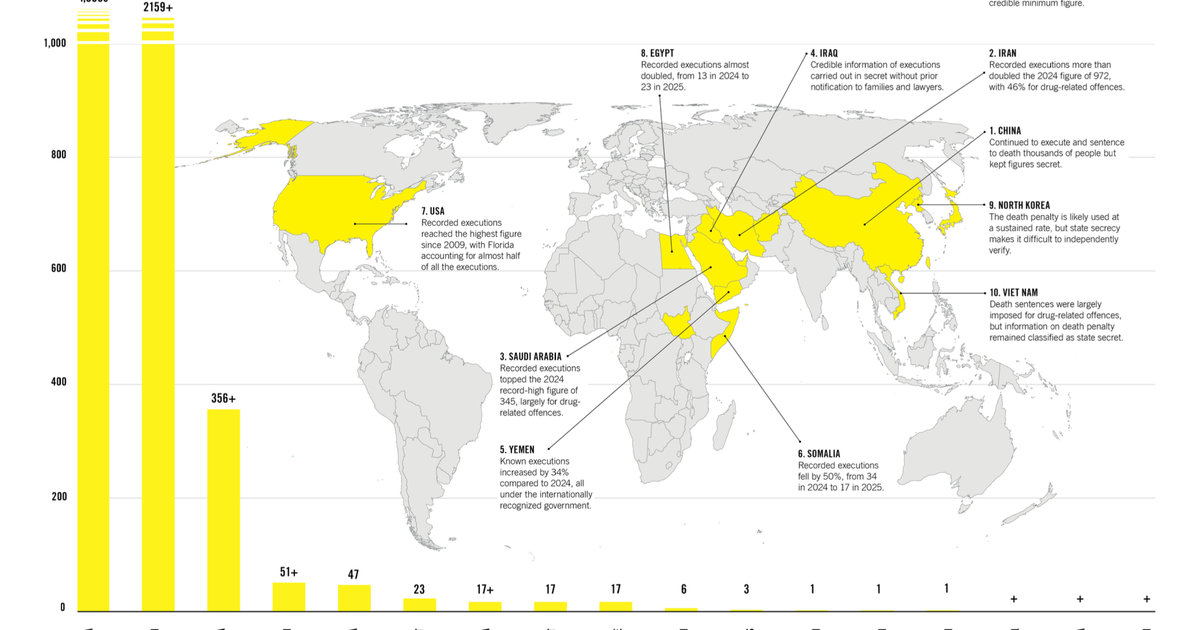
Amnesty International reported at least 2,707 executions globally in 2025, the highest documented total since 1981, with Iran accounting for at least 2,159 and more than doubling its prior-year total. Saudi Arabia, the U.S., Egypt, Kuwait, Singapore and several others also posted higher execution counts, while China is believed to have carried out additional executions that could not be verified. The article is primarily a human-rights and policy update, with limited direct market impact.
The market-relevant read-through is not humanitarian headline risk; it is policy-drift risk in jurisdictions where legal process is already subordinated to state power. That tends to widen the political-risk discount on local cyclicals, banks, and consumer names with domestic revenue exposure, while leaving export earners and firms with hard-currency balance sheets relatively insulated. The bigger second-order effect is on sanctions enforcement: a more coercive internal security posture usually correlates with tighter capital controls, more opaque procurement, and higher transaction friction for any foreign-linked counterparty.
For the Gulf, a sharper execution regime in the region raises the tail risk of episodic headline escalation, but it also reinforces the durability of authoritarian incumbency in the near term. That can be supportive for oil-adjacent assets if it reduces the probability of near-term regime softening, yet it simultaneously increases the probability of sudden sanctions tightening or diplomatic shocks. The better trade distinction is between longer-duration macro beneficiaries and short-duration event-risk names exposed to local consumer demand, tourism, and discretionary spending.
The U.S. angle is subtler: rising use of the death penalty is a marker of political hardening, which tends to intensify cleavages around criminal justice, immigration, and election rhetoric. That is more likely to matter for state-level legal services, private prison/monitoring vendors, and defense-linked domestic security spend than for broad equities. The consensus may be overestimating how much this changes global ESG screens, but underestimating how quickly it can translate into permit delays, NGO pressure, and compliance costs for firms operating in sensitive jurisdictions.
The contrarian view is that the headline spike may be less a new structural trend than a visibility effect: documented numbers are rising partly because more governments are being tracked, while the truly opaque regimes remain outside the count. If so, the trade is not to short broad EM risk, but to selectively fade domestic-demand names where reputational and regulatory friction is most likely to hit margins over the next 3-6 months.
AI-powered research, real-time alerts, and portfolio analytics for institutional investors.
Request DemoOverall Sentiment
strongly negative
Sentiment Score
-0.60
