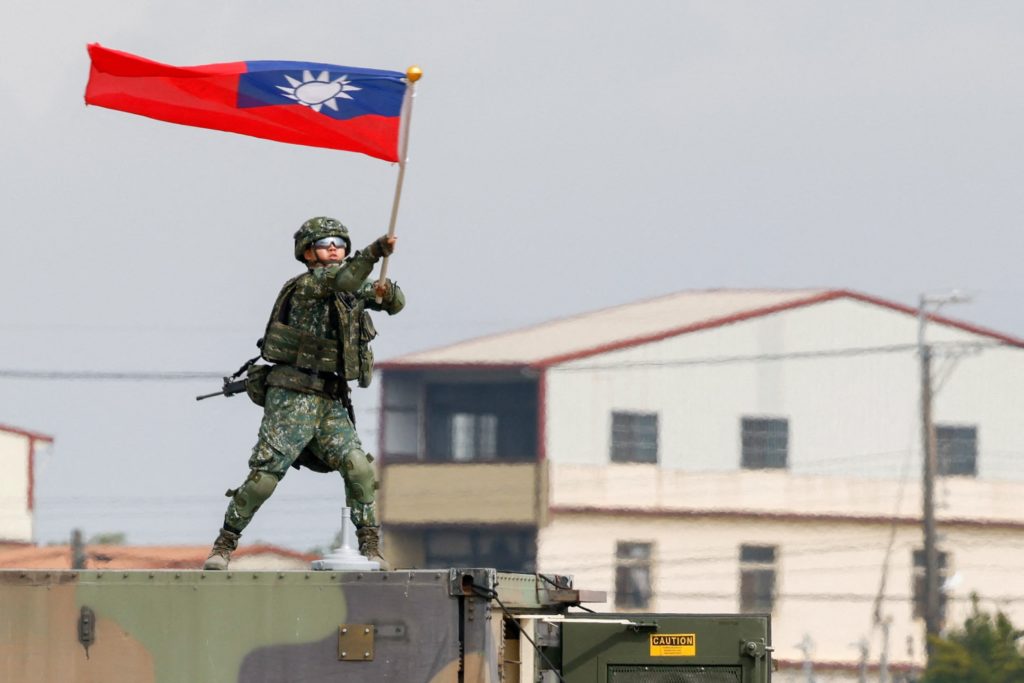
China removed its top army general in a move analysts interpret as consolidating loyalty to President Xi Jinping, a development that has heightened security concerns in Taiwan. Taiwanese officials fear that perceived U.S. actions — specifically a hypothetical capture of Venezuelan President Nicolás Maduro — could embolden Beijing to attempt a similar forcible action against Taipei, raising regional geopolitical risk that could prompt risk-off positioning for investors with exposure to Taiwan, China, and regional supply chains.
Market structure: heightened risk of coercive moves against Taiwan boosts demand for defense primes (Lockheed LMT, Northrop NOC, RTX) and accelerates risk premia on Taiwan-exposed assets (TSM, EWT, TWD). Expect a 5–15% re-rating range for small-cap Taiwan plays and 3–8% near-term upside for US defense stocks on order-flow/speculation within 1–6 months; semiconductor-equipment names (ASML) face policy/timing uncertainty that can compress multiples by 5–10% if export curbs tighten.
Risk assessment: tail risks include a kinetic incident (low-probability, high-impact) that could spike oil +15–30%, widen EM credit spreads 150–400bp, and cause semiconductor supply-chain shocks lasting quarters. Near-term (days–weeks) see volatility spikes and safe-haven flows into USD, JPY, Treasuries; medium-term (3–12 months) the market will re-price on sanctions, military exercises, and U.S. policy signals. Hidden dependencies: concentration of advanced node capacity in TSMC implies outsized real-economy knock-on effects if access is restricted.
Trade implications: tactical trades should be asymmetric — buy optionality in defense and tail hedges on Taiwan/EM exposure. Use short-dated puts or inverse ETFs to capitalize on sudden risk-off while owning longer-dated selective exposure to semiconductors if prices cheapen; increase cash or high-grade duration by 2–5% as volatility hedge. Timing: act within 1–6 weeks to capture repricing, scale out over 3–6 months.
Contrarian angles: consensus may overpay defense stocks into forward contracts and over-sell high-quality Taiwan tech, creating mean-reversion opportunities 6–12 months out. If no kinetic escalation occurs within 3 months, expect snapback in TSM/ASML (20–40% upside potential from dislocated troughs); downside of the obvious short-Taiwan trade is prolonged cheap financing-driven buybacks in U.S. defense that keep multiples elevated.
AI-powered research, real-time alerts, and portfolio analytics for institutional investors.
Request DemoOverall Sentiment
moderately negative
Sentiment Score
-0.40
