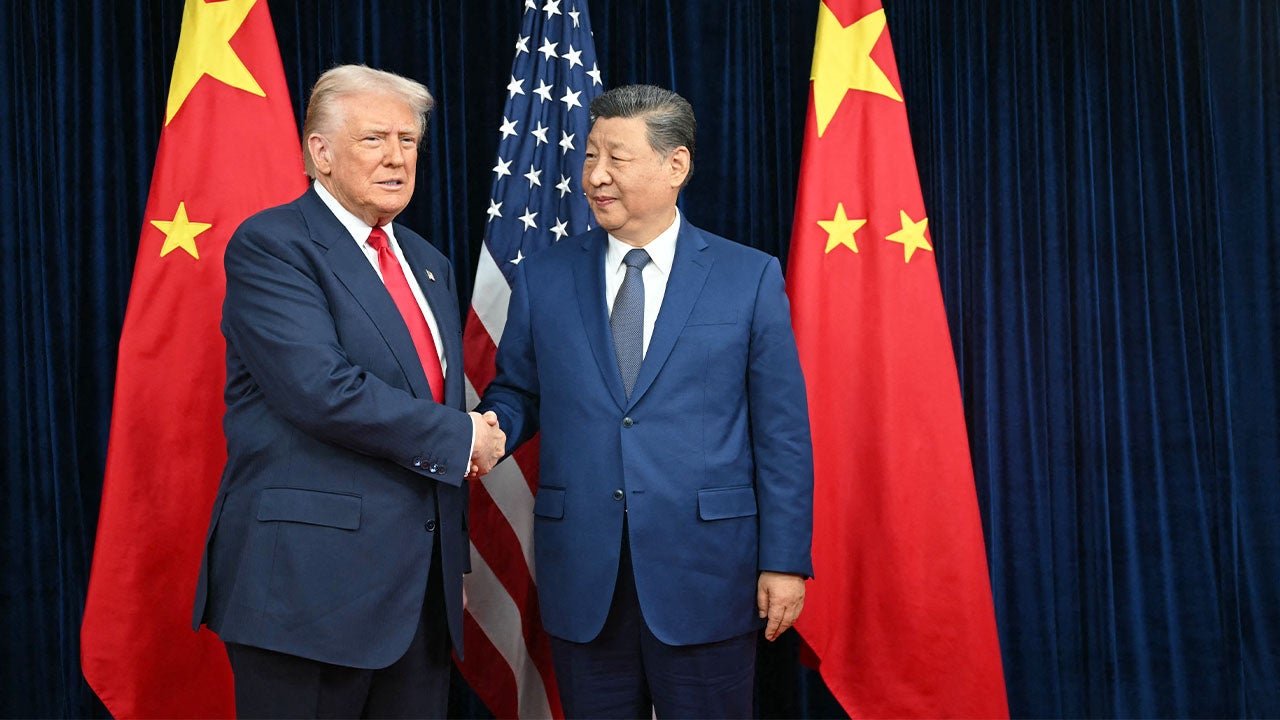
President Trump is heading to Beijing for high-stakes talks with Xi Jinping covering trade, advanced semiconductor restrictions, Taiwan, and the Iran conflict. The article highlights a fragile U.S.-China trade truce, ongoing sanctions friction involving Secretary of State Marco Rubio, and pressure on China to help reopen the Strait of Hormuz. The visit could influence global trade, chip policy, and geopolitical risk assets, though few major breakthroughs are expected.
The market setup is less about a binary “deal/no deal” outcome and more about which side can credibly extract concessions without triggering a visible escalation. The biggest second-order effect is that both governments appear to want stability enough to keep flagship corporates engaged, which reduces the odds of an immediate tariff shock but increases the probability of a longer, low-grade regime of selective restrictions, licensing delays, and rhetoric-driven volatility. That favors companies with pricing power and diversified end-markets, while punishing names whose China exposure is concentrated in a narrow set of end-demand or regulatory choke points. Semis remain the cleanest way to express the summit risk because policy can move faster than fundamentals. Even if headline language is constructive, any signal that advanced-node export controls will stay in place or broaden into tools/equipment would likely hit the higher-beta names first; the more durable beneficiaries are firms with China demand but non-China manufacturing footprints, or vendors selling products that sit just below the control threshold. The embedded risk is that optimism into the meeting can compress implied volatility, creating a favorable setup for long premium structures if expectations are too complacent into the event window. For the industrial/defense complex, the trip likely reinforces that geopolitical fragmentation is now a baseline scenario rather than a shock. That is supportive for aerospace and defense primes over the next 6-18 months because procurement and supply-chain localization are hard to reverse once initiated; it is less supportive for globally exposed logistics and hardware suppliers if the two sides start using permitting, customs, or licensing as leverage. In contrast, the headline around China’s leverage on energy routes is a reminder that any India/Middle East supply disruption would be more inflationary than growth-negative, which modestly favors real assets and commodity-linked cash flows over duration-sensitive growth. The contrarian angle is that consensus may be overestimating the durability of calm simply because a summit is occurring. If both sides leave Beijing with “framework language” but no verifiable implementation path, the market could quickly reprice to a disappointment trade, especially in crowded AI/semi winners that have run on de-escalation hopes. The better risk/reward is to assume the visit lowers near-term tail risk but does not change the medium-term direction: strategic decoupling continues, just at a slower and more bureaucratic pace.
AI-powered research, real-time alerts, and portfolio analytics for institutional investors.
Request DemoOverall Sentiment
neutral
Sentiment Score
-0.05
Ticker Sentiment
