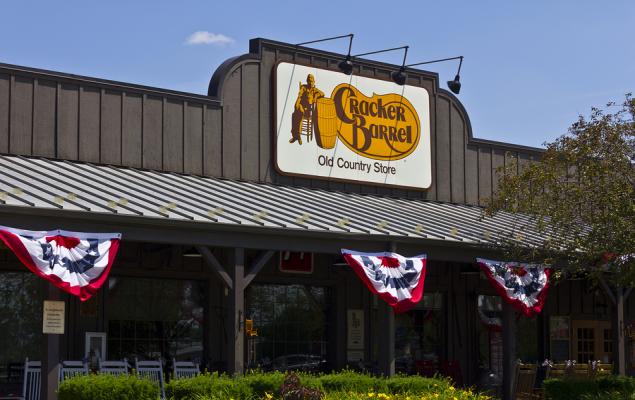
Cracker Barrel is expected to report a weak fiscal Q1 with the Zacks consensus at a loss of $0.68/share versus prior-year EPS of $0.45 and revenue consensus of $801.1M (‑5.2% YoY). Management cited a mid‑August brand refresh that drove a 7%–8% decline in traffic; Zacks’ model forecasts comps down 4.5% YoY, retail revenue down 4.6% to $154.1M, COGS up 2.1% to $264.3M, roughly $16M of incremental quarter costs, and adjusted EBITDA plunging 47.7% to $24M. Zacks notes an Earnings ESP of 0.00% and a Zacks Rank #4 (Sell), implying downside risk to the share price absent material upside surprises.
Market structure: Cracker Barrel (CBRL) is the clear near-term loser — management’s mid-August brand refresh correlates with an estimated 7–8% traffic hit, modelled -4.5% comps and a ~47.7% EBITDA drop to ~$24M for Q1, compressing pricing power despite planned 4–5% price moves. Winners are franchise/QSR models (LOCO, WING, QSR) that can lean on value promotions, higher frequency, and lower capex; retail SKUs and legacy mall‑anchored formats face inventory and sell‑through pressure as assortment narrows (~-4.6% retail rev). Demand signal: discretionary dining demand is softening — flow‑through of lost volumes (30–45%) means cost base is sticky and pricing will be an incomplete offset through FY26.
Risk assessment: tail risks include a permanent brand equity loss at CBRL (multi‑quarter traffic erosion), a social media backlash triggering franchisee disputes, or tariff-driven retail SKU shocks that depress margins further. Immediate (days): downside around the upcoming Q1 print and guidance; short-term (weeks–months): marketing spend ($16M incremental) and loyalty reactivation determine recovery; long-term (2–4 quarters): brand repair or structural share loss. Hidden dependencies: loyalty enrollment momentum and sentiment metrics (Net Promoter/Google Trends) are the most predictive second‑order variables; commodity/food inflation and bond spread widening amplify stress.
Trade implications: direct play — establish a tactical short in CBRL (2–3% portfolio) into earnings with a tight stop (8–10% adverse move) and profit buckets at -20% / -35%. Pair trade — go long LOCO and WING (1.0–1.5% each) vs short CBRL equal notional for 3‑month horizon; both LOCO and WING have positive Earnings ESP. Options — buy 30–60 day CBRL put spreads (debit spreads to cap cost) sized ~0.5% portfolio to express asymmetric downside; consider selling covered calls on QSR longs to finance carry. Rotate 20–30% of casual‑dining exposure into QSR/franchise names over 2–6 weeks.
Contrarian angles: consensus may over-penalize CBRL on a one‑quarter marketing/refresh misstep — if loyalty re‑engagement or a targeted promotion restores a 3–4% traffic improvement within 60–90 days, downside will be capped and the current sell rating could be overdone. Historical parallels: legacy brand refreshes often cause short-term traffic shocks but recover within 2–4 quarters if product quality and promos stick (example: post‑rebrand recovery at comparable casual concepts). Unintended consequence: aggressive discounting to win back customers could stabilize traffic but permanently compress EBITDA margins, creating a longer recovery path — a scenario where bonds widen before equities rerate.
AI-powered research, real-time alerts, and portfolio analytics for institutional investors.
Request DemoOverall Sentiment
moderately negative
Sentiment Score
-0.52
Ticker Sentiment
