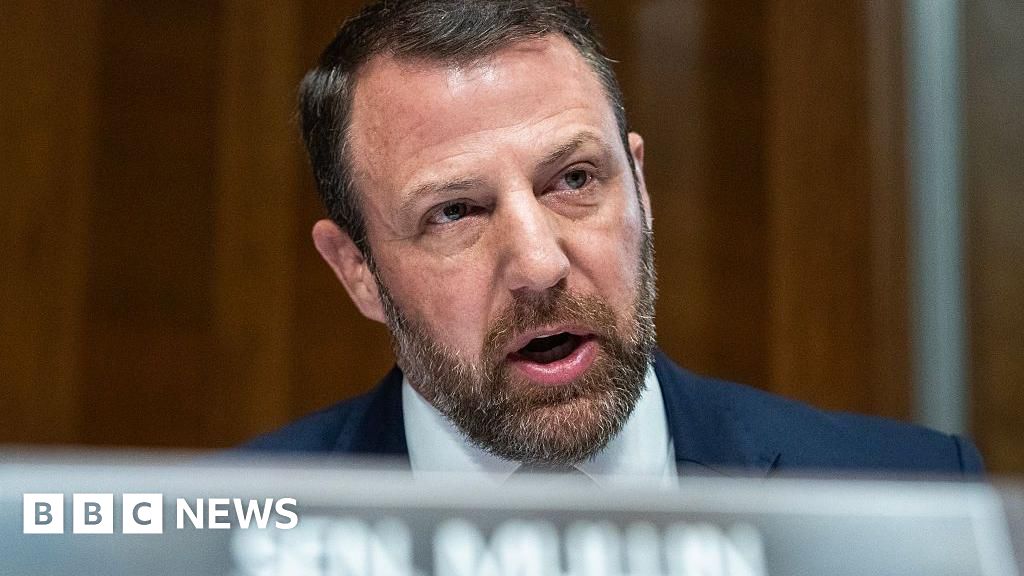
Senator Markwayne Mullin will testify to the Senate Homeland Security & Governmental Affairs Committee at 09:30 ET Wednesday as Trump’s nominee for DHS, with a full‑Senate confirmation vote possible later this month where a simple majority (51-49) is required. Mullin would assume leadership amid a partial DHS shutdown that has produced airport security staff shortages and long passenger queues, and he is expected to face scrutiny over implementation of Trump’s mass deportation policy and recent deadly incidents involving federal immigration agents that precipitated Kristi Noem’s removal.
Leadership turnover at a politically charged security agency amplifies two durable cross-sector forces: budgetary reallocation toward enforcement-related contracts and operational fragility at choke-points (airports, ports) where federal staffing is the marginal supply constraint. Contractors that provide detention, surveillance, and border processing services have embedded optionality—if the administration secures appropriations or reprioritizes existing funds, their revenue can rebase higher within 6–12 months because program ramps are contractor-friendly and capital-light. Conversely, transportation operators face concentrated shortfalls: a multi-week funding impasse that reduces frontline staffing compresses throughput, increases unit costs (overtime, turnaround time, fuel burn from delays) and reduces ancillary spend per passenger—effects that show up in quarterly revenue cycles, not just daily headlines. Key catalysts and tail risks are binary and time-boxed: the nominee’s confirmation vote (days–weeks) and any short-term budget continuation measure determine whether operational pain persists into peak travel season. Legal or reputational shocks tied to enforcement operations can trigger sudden funding claws-back or regulatory constraints, reversing upside for enforcement contractors within 60–120 days. Longer-term (12–24 months), appropriations battles and modular contract awards create asymmetric upside for mid-cap defense/security integrators but raise political/regulatory downside for firms with exposure to detention services. The market’s knee-jerk reaction will likely oscillate between “political theatre” and “policy-driven reallocation.” That creates a tidy pair trade: price in near-term travel disruption via short-duration protection on airlines or travel ETFs, while buying convexity into contractors that win if enforcement budgets re-expand. Watch two signals to rotate: (1) funding stopgap language in appropriation bills and (2) contract awards or emergency task orders to border/detention contractors—either will materially alter a 3–12 month P&L path for the names below.
AI-powered research, real-time alerts, and portfolio analytics for institutional investors.
Request DemoOverall Sentiment
neutral
Sentiment Score
0.00
