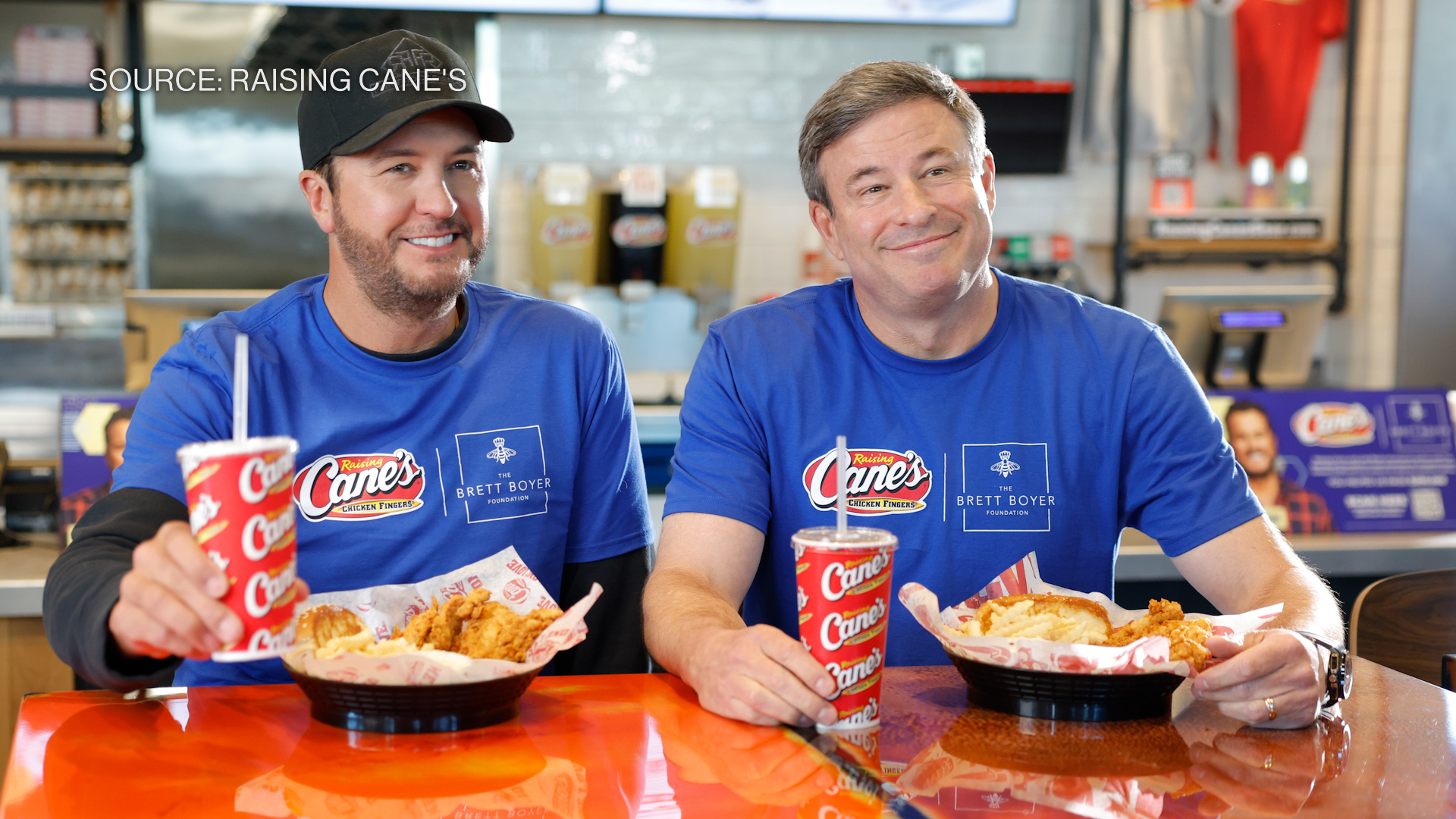
The 29‑year old fast‑casual chicken chain operates nearly 1,000 company‑owned restaurants and is growing at roughly 100 new units per year, targeting a US footprint of about 3,000 locations. Management emphasizes a company‑owned model (having bought back early franchisees, which they say raised sales >35%), strict quality/cook‑to‑order standards, celebrity‑led social marketing, and community activations. Internationally the brand operates ~35 outlets in the Middle East and plans openings in London (Piccadilly Circus) and Mexico next year; management referenced roughly $10 billion in annual sales as a sizing benchmark. The update signals steady organic expansion and disciplined operations rather than immediate market‑moving financial events.
Market structure: A company-owned, experiential chicken-finger chain scaling ~100 net new restaurants/year from ~1,000 today tilts winners toward upstream suppliers (Tyson TSN, Lamb Weston LW), commercial real estate landlords in suburban QSR corridors, and digital/social agencies that deliver low-cost impressions; franchisors reliant on scale and LTOs (YUM, QSR) are the most direct competitive peers under pressure for share in the mid-premium chicken segment. Competitive dynamics favor brands that protect food quality and service — the company-owned model preserves control but limits speed relative to franchising, implying steady share gains regionally rather than rapid national displacement; pricing power will be regional and tied to protein/potato input cost moves. Cross-asset: rising chicken/potato costs increase headline CPI food-at-home and compress restaurant margins, pressuring high-yield credit in heavily-levered franchisors and increasing implied vol in restaurant equities; FX exposure is small but UK/Mexico openings create localized FX and regulatory risk.
Risk assessment: Tail risks include a major recall or food-safety event, failed UK launch or political disruptions in Middle East partners, and labor-driven service deterioration; these could cause >20% local unit SSS declines and reputational damage. Near-term (days–3 months) impacts are negligible; short-term (3–12 months) hinges on UK/Piccadilly and Mexico openings and commodity price shocks; long-term (3–10 years) the plan to ~3,000 US units requires substantial capex and may force debt/equity raises. Hidden dependency: company-owned expansion is capital-hungry — balance-sheet strain is the non-obvious lever that could force a slow-down. Key catalysts: UK flagship openings, quarterly SSS above +4% or below +1%, and producer-price moves >+10% for chicken/potatoes.
Trade implications: Direct plays — establish a 2–3% long position in TSN and 1–2% long in LW within 30 days to capture upstream volume growth, with stop-loss at -10% and target +15% within 6–12 months. Pair trade — overweight MCD (2%) vs short YUM (1.5%) for 6–12 months: McDonald's scale and diversified menu hedge against niche chicken share shifts. Options — buy TSN 6-month call spreads ~5–10% OTM sized 0.5–1% portfolio to play protein upside while limiting premium risk. Rotate portfolio overweight Food Processors and underweight franchisor-heavy restaurant names (YUM, QSR) until SSS and commodity trends clarify.
Contrarian angles: Consensus underestimates capital intensity and cultural dilution risk from rapid company-owned expansion — a disciplined owner-operator can protect brand but may cannibalize margins if growth financed with debt; public market reaction often underprices supplier benefit (TSN/LW) and overprices franchise leverage (YUM/QSR). Historical parallel: viral chicken concepts (e.g., Popeyes) delivered short-term share surges followed by normalizing SSS; watch for SSS reversion to mean (within ±2% over 12 months) as a sell/short trigger. Unintended consequence — celebrity/social media-driven demand spikes are episodic; sustained unit economics must come from consistent SSS >+3% and controlled food-cost-to-sales ratio; if food-cost rises >200bp without SSS offset, consider reducing exposure within 3 months.
AI-powered research, real-time alerts, and portfolio analytics for institutional investors.
Request DemoOverall Sentiment
moderately positive
Sentiment Score
0.45
Ticker Sentiment
