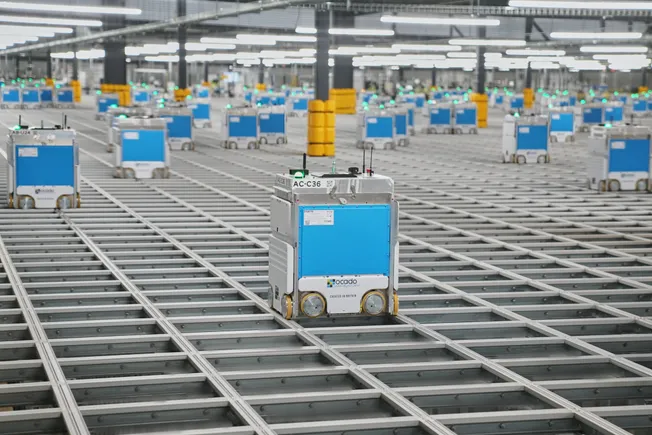
Kroger said it will close three robotic e‑commerce fulfillment facilities and make other e‑commerce adjustments, taking roughly $2.6 billion of charges while projecting a $400 million improvement to e‑commerce profitability; the move marks a sharp reversal of its high‑profile automation push with U.K. partner Ocado. Interim CEO Ron Sargent said Kroger will perform a site‑by‑site review and refocus on leveraging its 2,700+ stores, deepen third‑party delivery partnerships and pilot capital‑light, store‑based automation, reflecting recognition that Ocado’s large, out‑of‑city centers and a U.S. consumer preference for faster delivery made the original model uneconomic. The retreat is a material setback for Ocado, whose shares have plunged back to levels last seen when it IPO’d 15 years ago, and signals broader caution about large‑scale automated fulfillment investments in U.S. grocery.
Kroger said it will close three robotic e‑commerce fulfillment facilities and take approximately $2.6 billion of charges, while projecting the closures and other adjustments will yield a $400 million improvement to e‑commerce profitability. This marks a clear reversal of the company’s prior expansion with U.K. automation partner Ocado after Kroger paused the Ocado program in September 2023 and closed three spoke facilities in March for not meeting performance benchmarks.
Advisors and Kroger executives pointed to structural flaws in the out‑of‑city, high‑capital Ocado centers—insufficient order density and long delivery distances—and to U.S. consumers’ stronger preference for delivery speed, which has advantaged Instacart and DoorDash as they roll out faster options. Interim CEO Ron Sargent has initiated a site‑by‑site review and announced a strategic refocus on Kroger’s fleet of more than 2,700 supermarkets, deeper third‑party delivery partnerships, and pilots of capital‑light, store‑based automation.
The retreat is a material setback for Ocado, whose shares have fallen back to levels seen at its 15‑year‑old IPO, and signals broader investor skepticism about large, centralized automated fulfillment in U.S. grocery. Near‑term Kroger faces earnings and cash‑flow pressure from the $2.6 billion hit, but the potential $400 million uplift and lower capital intensity from store‑based approaches could improve margins if execution succeeds; key risks are additional impairments, failed store pilots, and increased reliance on third‑party delivery economics.
AI-powered research, real-time alerts, and portfolio analytics for institutional investors.
Request DemoOverall Sentiment
moderately negative
Sentiment Score
-0.55
Ticker Sentiment
