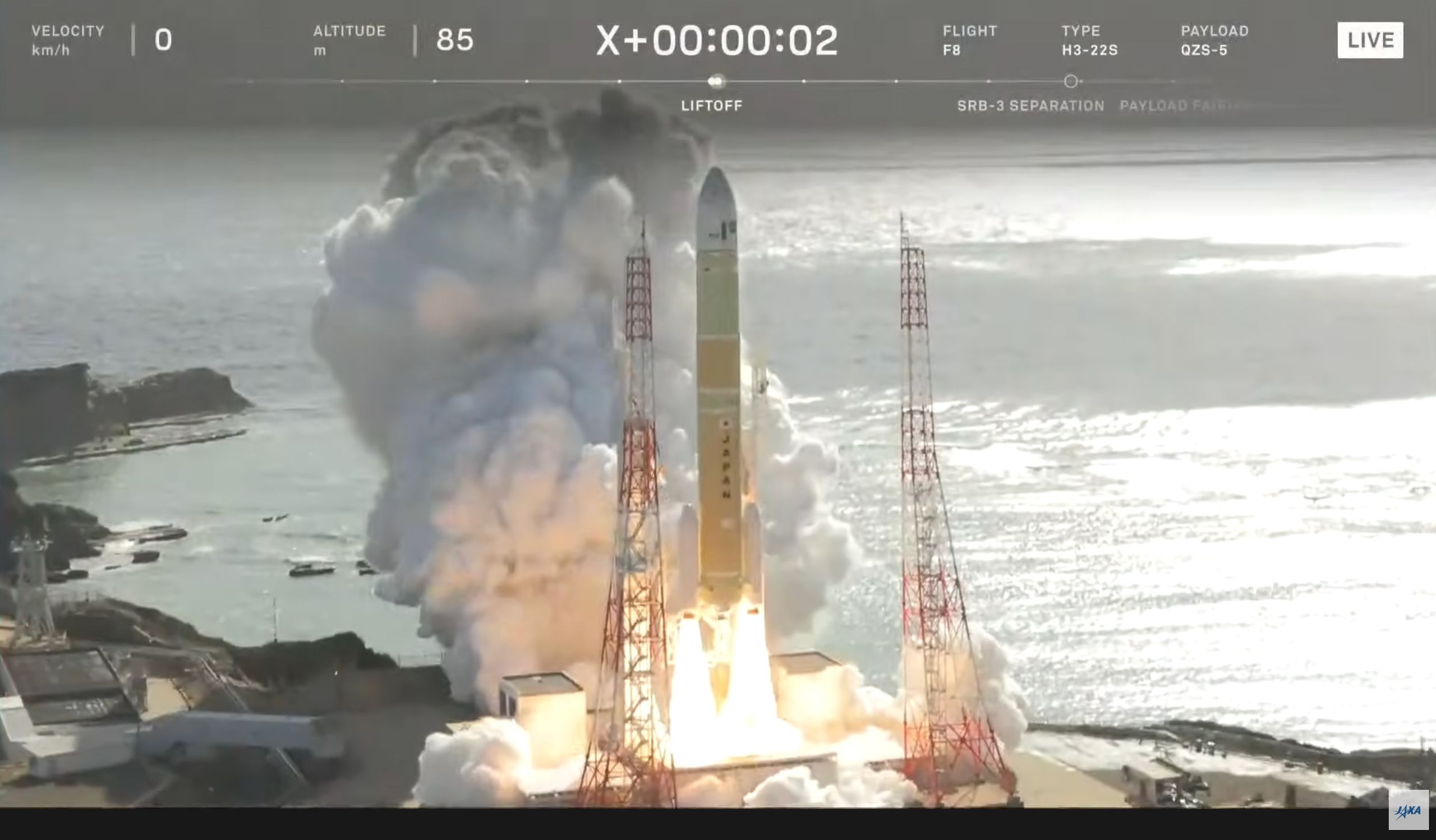
Japan's seventh H3 rocket mission launched on Dec. 21 (local Dec. 22) from Tanegashima carrying the 4,800 kg Michibiki-5 (QZS-5) navigation satellite failed after the second-stage engine's second ignition shut down prematurely, leaving the payload out of its planned geosynchronous orbit. The vehicle, developed by JAXA and Mitsubishi Heavy Industries, had recovered from a March 2023 debut failure with five consecutive successes, but JAXA has formed a task force led by agency chief Hiroshi Yamakawa to investigate; the anomaly risks schedule delays and additional costs for the QZSS constellation (planned to reach 11 spacecraft) and may have reputational and contractual implications for program partners.
Market structure: The immediate winners are non-Japanese commercial launch providers (e.g., RKLB) and global defense primes that can absorb displaced payload demand; the clear loser is Mitsubishi Heavy Industries (7011.T) and reputationally JAXA/QZSS operators. Customers facing schedule risk will likely reprice launch capacity upward — expect 5–20% premium for near-term slots if H3 flights are paused for weeks, tightening supply of launch seats.
Risk assessment: Tail risks include a prolonged H3 grounding or regulatory probe that forces cancellations or large warranty/recall costs (order-of-magnitude: JPY tens of billions), and a political response that either socializes costs or guarantees continuity. Near-term (days) equity volatility and option IV spikes; short-term (30–90 days) catalyst is JAXA task-force report; long-term (6–24 months) outcome depends on government funding decisions and customers’ re-contracting behavior.
Trade implications: Direct trades: short reputational and service-risk in 7011.T and buy optional exposure to alternate launch capacity (RKLB) and US defense primes (LMT, NOC) that gain integration work. Options: use near-dated puts on 7011.T to capture IV + directional move and calendar spreads (buy longer-dated calls / sell nearer puts) to play recovery. Rotate sector exposure from Japan-focused aerospace toward US defense/space over 1–6 months.
Contrarian angles: The market may underprice a fast government backstop — Japan historically funds strategic programs; a decisive rescue (within 60–120 days) would sharply limit downside and create a short-squeeze on 7011.T. Also note the H3 had recovered after an initial failure in 2023, so a measured buy-on-confirmation (task-force root-cause cleared) in 3–6 months could capture asymmetric upside.
AI-powered research, real-time alerts, and portfolio analytics for institutional investors.
Request DemoOverall Sentiment
moderately negative
Sentiment Score
-0.50
