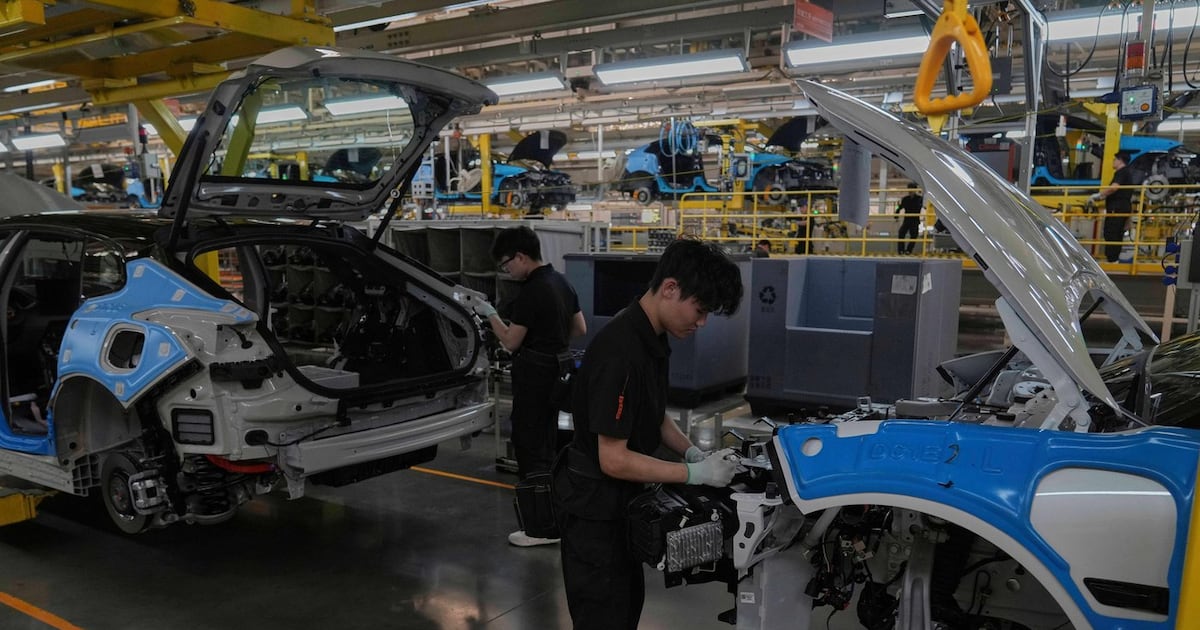
Car dealers say a potential agreement to facilitate China-made electric-vehicle access to the Canadian market could benefit Canadian consumers by expanding model choice, increasing inventory and putting downward pressure on prices. For investors, the development implies potential competitive pressure and margin compression for domestic OEMs and parts suppliers, shifts in market share toward lower-cost foreign entrants, and supply-chain realignments; the piece offers qualitative dealer views but provides no concrete figures on tariffs, volumes or timing.
Market structure: A China-to-Canada EV supply liberalization would likely make independent and multi-franchise dealers (TSX: ACQ) and large used-car retailers (AN, LAD) short-term beneficiaries as margins on price-competitive Chinese EVs drive incremental foot traffic and trade-ins. Traditional OEMs (GM, F) could face pricing pressure and margin erosion in Canada over 12–36 months as lower-cost models capture 5–15% more volume in entry and mid-price segments, shifting share toward value-oriented offerings. Cheaper EV imports also signal downward pressure on battery-metal demand (lithium, nickel, copper), implying commodity-price downside risk vs. consensus bullish forecasts over 6–24 months.
Risk assessment: Tail risks include rapid policy reversal (anti-dumping tariffs within 30–90 days), diplomatic escalation restricting shipping lanes, or mass recalls that force import bans — each could reverse flows and spike volatility. Near-term (days–weeks) price action will be headline-driven; medium-term (3–12 months) depends on dealer inventory adjustments and financing availability; long-term (2–5 years) centers on structural share shifts and dealer-buyer relationship models. Hidden dependencies: dealer profitability relies on financing (Canadian banks: TD, RY) and parts/service revenue, which can offset new-car margin compression by 30–50%.
Trade implications: Immediate tactical trades: overweight Canadian dealer exposure (ACQ.TO) via 3% position size on expectation of +15–30% share gain in used/entry EV sales within 12 months, hedge with short 1–2% positions in legacy OEMs (GM, F) via 3–6 month put spreads to limit downside. Commodity/FX plays: reduce long LIT exposure by 25% and add short copper (COPX) or buy 3–9 month put spreads if imports grow >10% QoQ; consider long CAD-neutral yield product if import-led disinflation reduces BoC tightening probability.
Contrarian angles: Consensus assumes dealers win and OEMs lose; miss is service and financing revenue uplift for dealers that could more than offset new-car margin squeeze — dealers may become distribution hubs for Chinese OEMs rather than victims. Risks of overdone pessimism on lithium/nickel could create entry points if supply-demand tightness persists globally; historical parallel: affordable Japanese imports in the 1980s initially disrupted US OEMs but ultimately spurred efficiency gains and new market segmentation, implying partial recovery scenarios for legacy players over 3–5 years.
AI-powered research, real-time alerts, and portfolio analytics for institutional investors.
Request DemoOverall Sentiment
mildly positive
Sentiment Score
0.28
