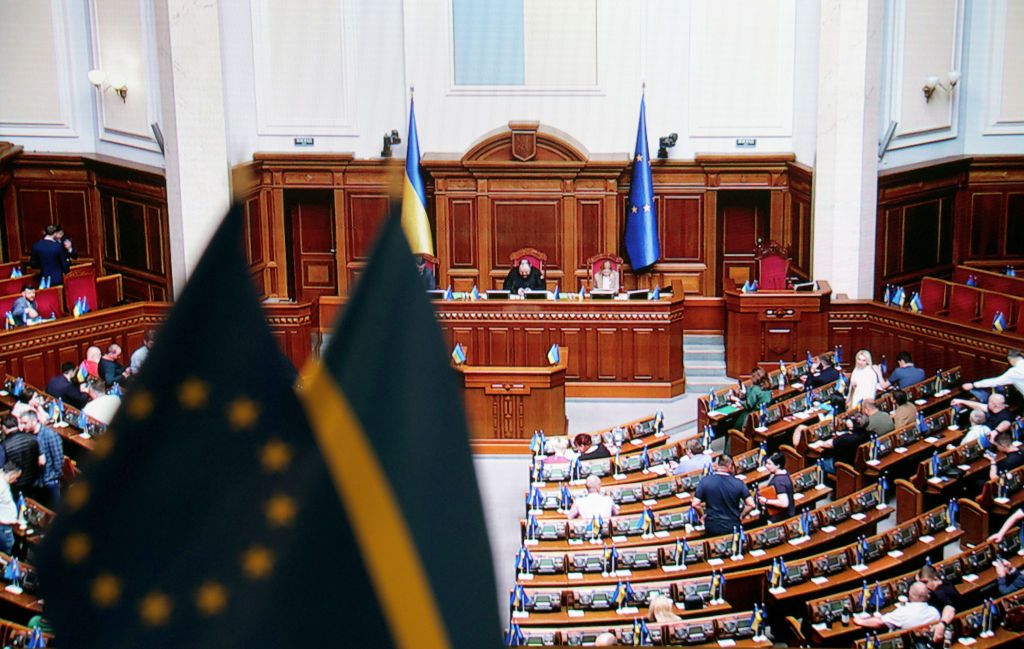
Adopting 11 delayed reforms would unlock €4.0bn (~$4.6bn) from the EU, but Kyiv has missed multiple 2025 deadlines and faces a funding cliff as cash could run out by end of spring. A separate €90bn EU loan remains blocked by Hungary, Ukraine risks missing IMF's $8.1bn program tax conditions (deadline Mar 31) and must pass four reforms by Apr 20 to unlock >$3bn from the World Bank. Failure to implement measures will delay large multilateral financing and materially raise sovereign liquidity and fiscal stress.
A funding shock of the type implied by conditional withholding rapidly compresses sovereign liquidity and forces two immediate transmission channels: central bank reserve drawdowns and private-sector deposit flight. Expect currency depreciation pressure and higher short-end sovereign funding costs within weeks, which in turn forces the government to prioritize FX cashflows (military imports, debt service) and defer capex — a policy mix that amplifies recession risk and credit deterioration over the next 3–9 months.
Banks and corporates with concentrated exposure to the sovereign or to the affected domestic currency are the natural second-order casualties; loss of fiscal backstop raises provisioning needs and can trigger regulatory capital actions. Conversely, large defense and logistics suppliers with hard-currency revenues stand to see accelerated invoicing and earlier receipts if emergency external financing is sourced via NATO/EU procurement channels — a multi-quarter revenue push rather than an immediate fiscal solution.
Catalysts that would reverse the funding squeeze are political/compliance fixes or stepped-up bilateral lending; these are binary and can materialize in days if concessions are struck, or evaporate for months if they become bargaining chips. Tail-risk includes a partial restructuring or temporary capital controls, which would crater foreign-holder liquidity and widen CDS spreads materially; probability is non-trivial if liquidity metrics at the central bank and domestic banks worsen concurrently.
From a market-structure standpoint, this is a volatility event that favors asymmetric hedges: buy protection on sovereign/financial credit and FX puts in the near term, while selectively deploying contrarian long-risk should a rapid political settlement appear (sell volatility, buy spread compression). Position sizing should account for high idiosyncratic event risk and low cross-asset correlation in stressed episodes.
AI-powered research, real-time alerts, and portfolio analytics for institutional investors.
Request DemoOverall Sentiment
strongly negative
Sentiment Score
-0.60
