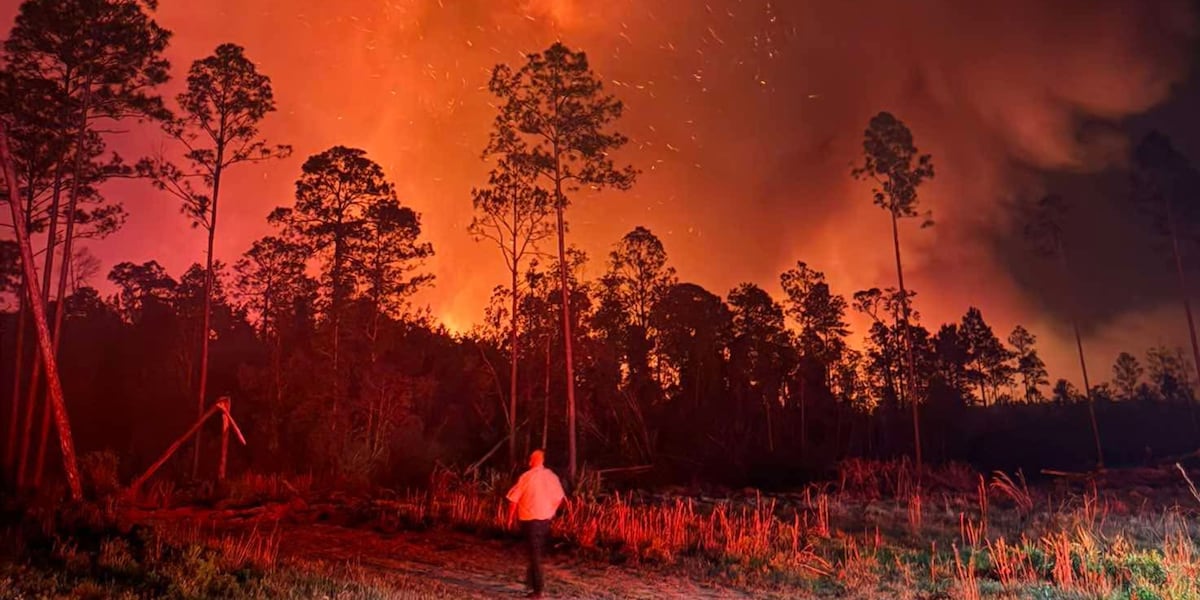
The Pineland Road Fire in Clinch County, Georgia has grown to 29,606 acres and is only 10% contained, with anticipated containment projected for May 31. The blaze began just before 5 p.m. on April 18 and expanded from an initial 2,500-acre estimate. The article is primarily a public-safety update and is unlikely to have direct market impact beyond local disruption.
The immediate market read is not about direct asset damage so much as the dispersion between insured and uninsured exposure. Regional utilities, timber, rail, and trucking names with asset concentration in the Southeast face a short-duration operating risk from outages, access restrictions, and precautionary closures; meanwhile, firms with diversified footprints may see only nuisance-level disruption. The more important second-order effect is on supply logistics: even a localized fire can tighten last-mile freight, delay lumber/feed/chemical shipments, and create temporary price spikes that never show up in headline indices but can hit quarterly margins.
For insurance, this is usually a smaller net event than hurricanes, but the mix matters: a long-burning fire raises claims on property, farm, and inland marine lines while also pressuring reinsurance sentiment if multiple Southern events cluster in the same season. The real earnings risk is not one catastrophe, but a higher loss-cost assumption in the next renewal cycle. That means the broader read-through is strongest for exposed regional carriers with thin reserve cushions, not the mega-caps that can absorb one-off volatility.
The contrarian angle is that the market often overprices the headline acreage and underprices recovery speed. If containment improves within the stated multi-week window, most of the economic damage is likely front-loaded into a few reporting periods, while the equity impact can fade quickly unless there is follow-on wind or drought reinforcement. That makes this more of a tactical volatility trade than a structural short, with the best opportunities likely in options where the premium can decay once the fire stops accelerating.
The main catalyst to watch is weather: a shift in wind, humidity, or rainfall could sharply reduce tail risk in days, while continued dry conditions would extend the event into a months-long reserve and logistics story. If evacuation zones expand toward higher-value timber or agricultural acreage, the economic impact could widen materially, but absent that, the damage should remain regional and manageable for diversified corporates.
AI-powered research, real-time alerts, and portfolio analytics for institutional investors.
Request TrialOverall Sentiment
strongly negative
Sentiment Score
-0.55
