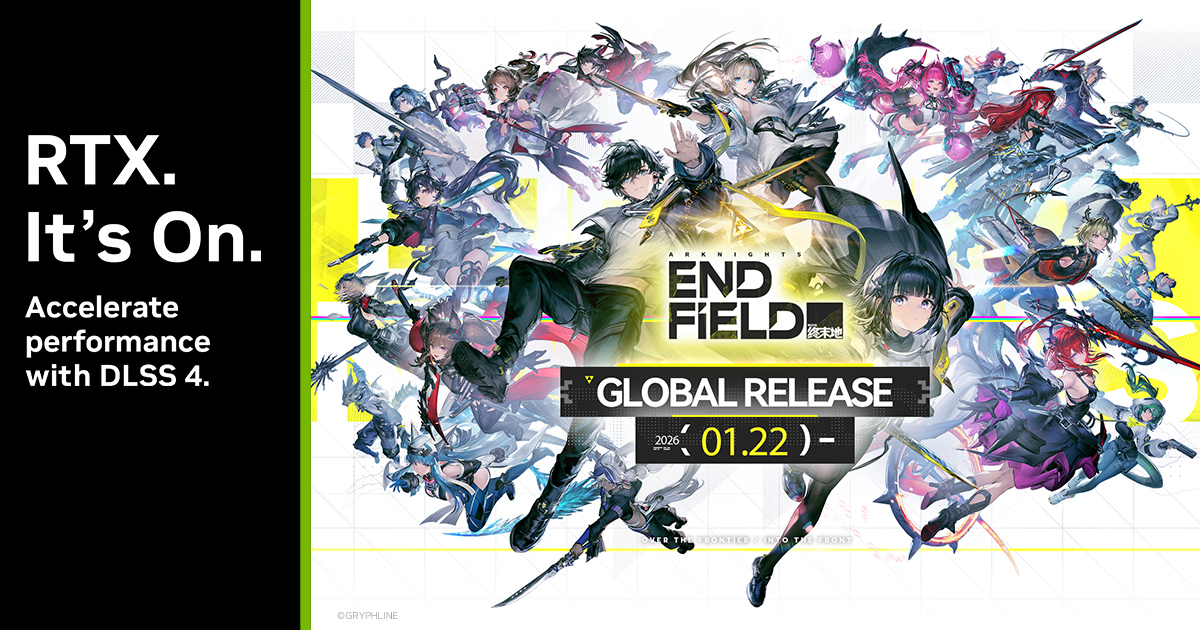
NVIDIA continues to expand RTX and DLSS adoption across the gaming ecosystem, with over 800 RTX-enabled games and new day-one and demo integrations announced: Arknights: Endfield launches with DLSS 4 (Multi Frame Generation) and DLSS Super Resolution (claiming ~3X frame-rate uplift at 4K on GeForce RTX 50 Series and enabling 480 fps caps at lower resolutions), Styx: Blades of Greed demo (DLSS 4/Frame Generation) available ahead of its Feb. 19 release, No Rest for the Wicked adds four-player co-op on Jan. 22, and The Gold River Project launches Jan. 23 with DLSS support. NVIDIA also offers an NVIDIA app upgrade path to 2nd Generation transformer models (DLSS 4.5 Super Resolution) for higher fidelity, underscoring continued product-led performance improvements that may modestly bolster investor sentiment around NVIDIA's GPU and software ecosystem adoption.
Market structure: NVIDIA (NVDA) is the clear direct beneficiary — DLSS 4/4.5 and Reflex integrations across >800 titles increase GPU value proposition, raising willingness-to-pay for GeForce RTX 40/50-series and accelerating upgrade cycles (article cites ~3x frame uplift at 4K). Console-first studios and non-accelerated GPU vendors (price-sensitive OEMs, some integrated GPU makers) are relatively disadvantaged as differentiated ray-trace/AI features become table-stakes for premium PC gaming.
Risk assessment: Near-term risks include supply shocks (foundry/logistics) and quality regressions in DLSS overrides; medium-term regulatory/antitrust or export-control actions on advanced accelerators are tail risks that could reduce TAM. Hidden dependencies: monetization depends on recurring GPU refresh cycles and cloud/GaaS uptake — game integrations drive perception but not immediate material revenue until hardware or subscription attach follows. Key catalysts: NVDA earnings (next 30–90 days), GTC announcements, major AAA titles shipping with native DLSS 4/4.5.
Trade implications: Primary trade is long NVDA equity/exposure with size scaling on pullbacks; use defined-risk options to express upside while controlling Vega. Relative trade: long NVDA / short AMD (or broad consumer GPU peers) to isolate uplift from proprietary AI/gaming stack. Cross-asset: stronger NVDA growth supports semi capex and raises equity volatility (higher implied vols), slightly pressuring IG bond spreads on rotation into risk assets.
Contrarian angles: The market may be over-indexing on gaming headline wins vs. data-center revenue drivers — gaming feature parity alone unlikely to sustain multiple expansion. Unintended consequences include sharper regulatory scrutiny as NVDA’s SDK becomes de facto standard, and possible competitive catch-up (software-level upscalers) that compresses GPU pricing power over 12–24 months.
AI-powered research, real-time alerts, and portfolio analytics for institutional investors.
Request DemoOverall Sentiment
moderately positive
Sentiment Score
0.45
Ticker Sentiment
