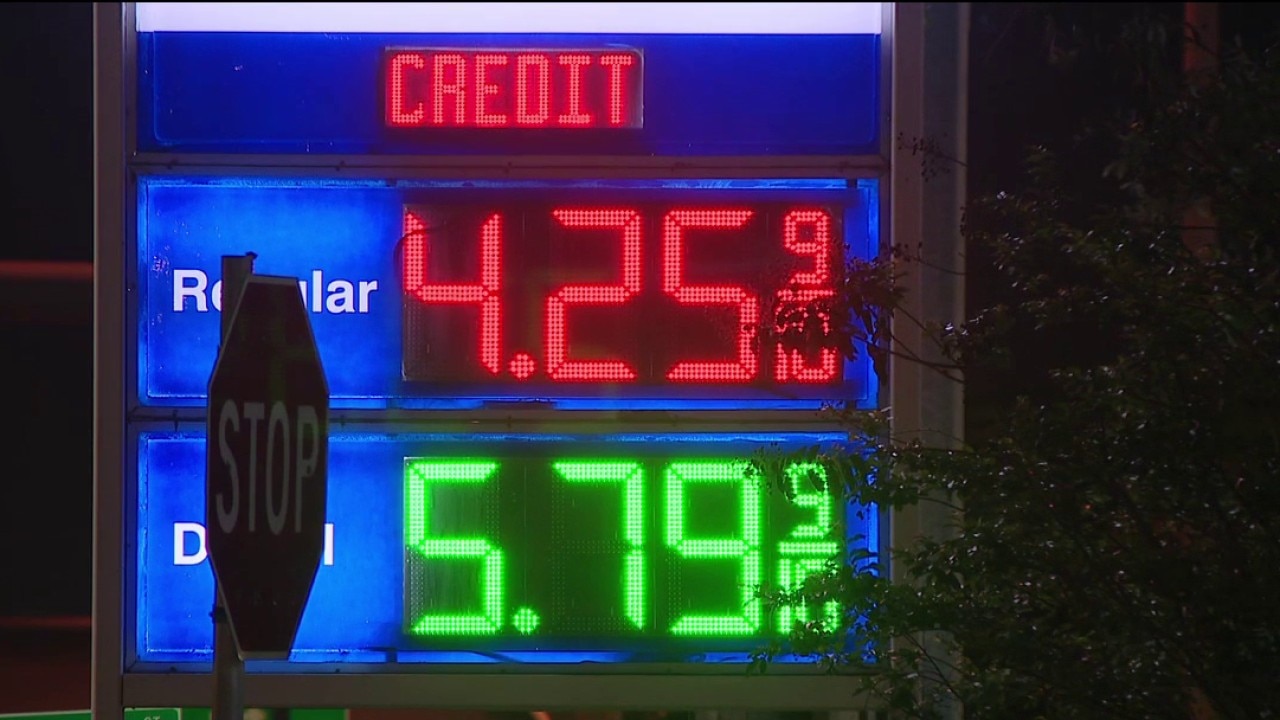
Gasoline in the Tampa Bay Area is now averaging above $4/gal (example: a Tampa station rose from $3.98 to $4.25; statewide average $4.12), roughly $1.30 higher than a month ago. Diesel has climbed even faster—more than $2/gal month-over-month—raising freight-cost risk that could push consumer prices higher. Analysts point to the conflict constraining roughly 20% of global oil supply at the Strait of Hormuz and warn prices may continue to rise if the disruption persists.
Winners in a sustained crude-up scenario are refiners and downstream wholesalers that can capture wider rack-to-retail spreads and rotate yields toward diesel — think Valero and PBF — and fuel retailers with sticky convenience margins. Losers are fuel-intensive movers (truckers, air freight) and margin-compressed consumer discretionary retailers; diesel moves are transmitted quickly to trucking unit economics, raising freight rates within 2–6 weeks and pressuring same-store sales for margin-sensitive retailers over the following quarter.
Second-order effects: a $2/gal-plus month-on-month diesel move materially boosts CPI components tied to transport and core goods with a 1–3 month lag, increasing the odds of sticky inflation surprises that could complicate the Fed’s easing timeline. For corporates, expect 1) accelerated pass-through to spot freight contracts, 2) higher inventory carrying costs for low-turn retailers, and 3) upward revisions to COGS for food/CPG for at least two reporting cycles.
Key catalysts and timeframes: headlines out of the Strait of Hormuz, an SPR release, or an OPEC+ policy response can swing front-month oil by 8–15% within days; durable demand destruction or a Chinese growth slowdown would operate over months and cap upside. The most plausible reversal is diplomatic de-escalation or a coordinated SPR + strategic refinery yield shifts to diesel, each capable of knocking crude back by ~10% in 2–8 weeks.
Contrarian angle: retail pump spikes often overshoot wholesale fundamentals due to local rack mark-ups and logistical frictions; refiners can shift output to diesel and narrow price dispersion within 4–8 weeks, so a timed mean-reversion trade on near-term crude or retail margins has asymmetric payoff if diplomacy or logistical adjustments occur.
AI-powered research, real-time alerts, and portfolio analytics for institutional investors.
Request DemoOverall Sentiment
mildly negative
Sentiment Score
-0.25
