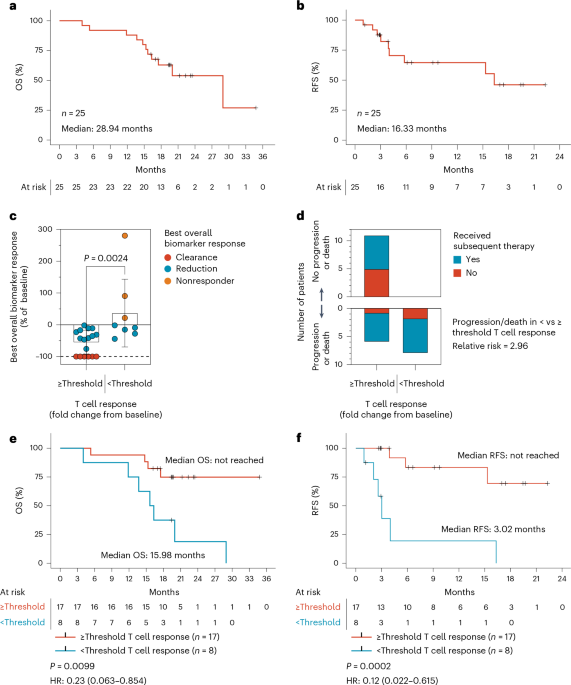
Final results from the Phase 1 AMPLIFY-201 trial of Elicio Therapeutics' ELI-002 2P vaccine show significant clinical benefit in mKRAS-mutated pancreatic and colorectal cancer patients with minimal residual disease. Patients with robust mKRAS-specific T-cell responses (above a 9.17-fold increase) achieved substantially prolonged median radiographic relapse-free survival (not reached vs. 3.02 months) and overall survival (not reached vs. 15.98 months) compared to those below this threshold. The vaccine induced potent, sustained T-cell immunity and antigen spreading, suggesting its potential to delay tumor recurrence in this high-risk population, particularly notable for pancreatic cancer, with a Phase 2 trial ongoing.
Final results from the Phase 1 AMPLIFY-201 trial of Elicio Therapeutics' (ELTX) vaccine, ELI-002 2P, demonstrate a statistically significant correlation between immunogenicity and clinical outcomes in patients with mKRAS-mutated pancreatic and colorectal cancer with minimal residual disease. The study established a clear efficacy signal linked to a 9.17-fold increase in mKRAS-specific T-cell response; patients exceeding this threshold had a median relapse-free survival (RFS) and overall survival (OS) that were not reached, compared to 3.02 months RFS and 15.98 months OS for those below the threshold. This translates to highly significant hazard ratios of 0.12 for RFS (P=0.0002) and 0.23 for OS (P=0.0099). The vaccine induced potent T-cell responses in 84% of all patients and 100% at the two highest dose levels, alongside antigen spreading in 67% of evaluated patients, suggesting a broadening of the anti-tumor immune response. The reported median OS of 28.94 months for the cohort, particularly the pancreatic cancer subset, compares favorably to historical data showing a median OS of approximately 17 months in this high-risk population. While limited by a small sample size and non-randomized design, these compelling results provide a strong rationale for the ongoing randomized Phase 2 study.
AI-powered research, real-time alerts, and portfolio analytics for institutional investors.
Overall Sentiment
strongly positive
Sentiment Score
0.85
Ticker Sentiment
