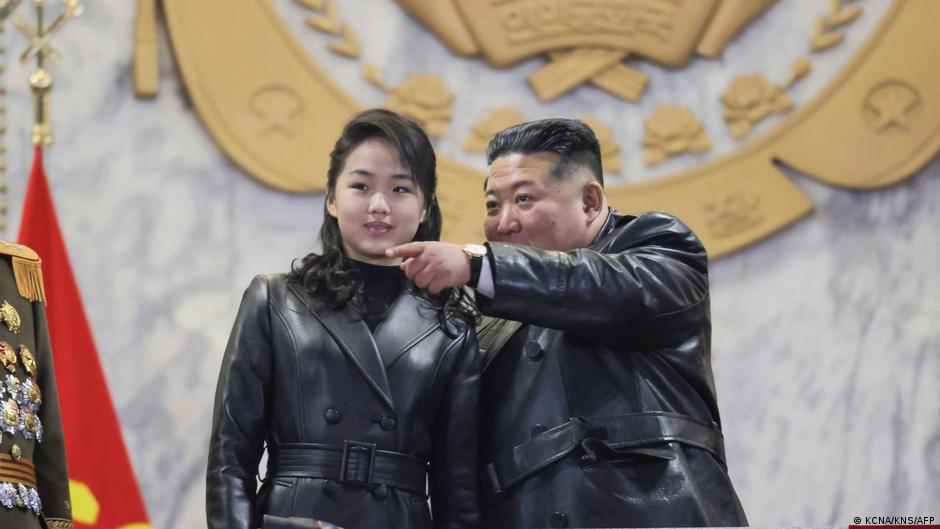
South Korea's NIS on April 6, 2026 publicly assessed that Kim Jong Un's daughter (believed to be Kim Ju Ae) is the likely political successor, upgrading its earlier 2024/2026 tracking to an intelligence-backed judgment. The move raises geopolitical risk and could modestly affect defense-related and regional risk-sensitive assets, but the assessment is provisional and may change if North Korea formally designates another heir or reveals more information.
A clearer succession narrative materially raises the probability of choreographed coercive signaling from Pyongyang over the next 3 months as the regime consolidates legitimacy — expect a higher cadence of missile tests, parade-style displays, and stylized visits to military units that in turn drive short-term demand for regional missile defense upgrades and ISR procurement. Procurement cycles are slow, but the political cover this creates accelerates near‑term deal flow (requests for proposals, accelerated tests, political justification) with visible contract timing clustered in the 6–18 month window.
Second-order beneficiaries are suppliers of integrated air and missile defense and long‑range radar (prime contractors and their subsystem vendors); governments in Seoul, Tokyo and Washington prefer proven, quickly deployable kits, favoring primes over speculative small-caps. Conversely, markets that price a high collapse/contagion premium (JPY, gold, some Asian sovereign CDS) may see that premium compress if continuity is perceived as reducing tail risk — this re-rates regional asset allocation over quarters, not days.
Key tail risks: a sudden health event, a public introduction of an alternative heir, or an internal purge would flip risk premia in days and trigger sharp spikes in volatility and safe-haven flows; the single biggest catalyst to watch is a formal public investiture (or lack thereof) inside 6–12 months, which will either entrench the market’s new equilibrium or force a re-pricing of systemic risk. Finally, while defense equities are the obvious trade, the consensus underappreciates that increased predictability can reduce urgency for some one‑off big-ticket buys, making option-structures preferable to outright cash exposure.
AI-powered research, real-time alerts, and portfolio analytics for institutional investors.
Request DemoOverall Sentiment
neutral
Sentiment Score
0.00
