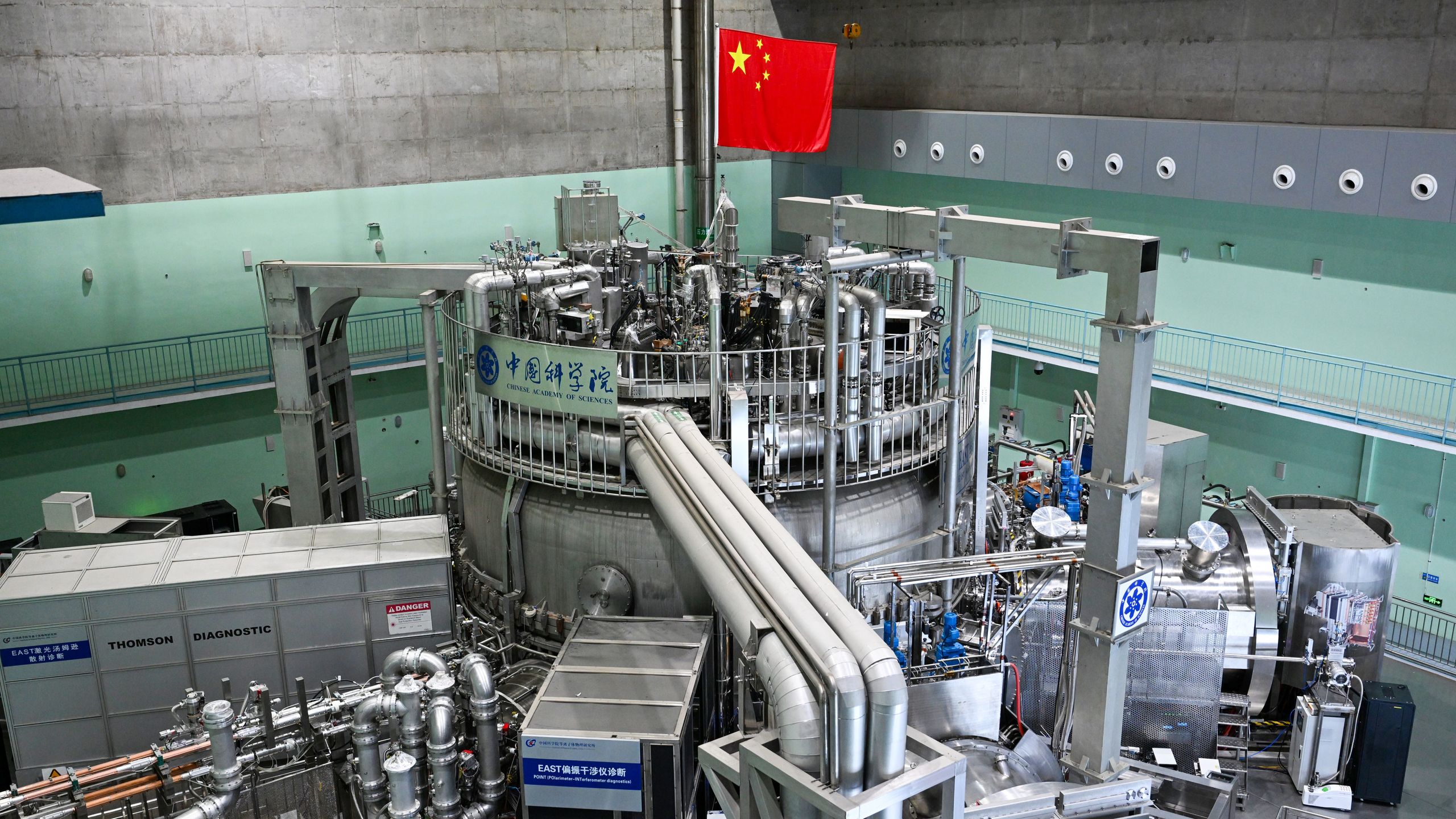
China's Experimental Advanced Superconducting Tokamak (EAST) sustained stable plasma at extreme densities of about 1.3–1.65 times the Greenwald Limit by controlling initial fuel gas pressure and electron cyclotron resonance heating, enabling access to a theorized 'density-free regime' for the first time (Science Advances, Jan. 1). While the result offers a practical, scalable pathway to extend density limits in tokamaks and informs ITER and other reactor designs, fusion ignition remains unachieved and commercial impact is long-term, leaving near-term market implications limited.
Market structure: The EAST result is a technology-positive signal for tokamak component suppliers (cryogenics, high-field magnets, power supplies) and national R&D programs, not an immediate demand shock to power markets. Expect incremental pricing power for niche suppliers (Chart Industries GTLS, Linde LIN, American Superconductor AMSC) as projects scale; uranium miners (Cameco CCJ, URA ETF) face structural downside only if commercial fusion achieves cost parity, which is a multi‑decade outcome. Near-term merchant power generators and oil majors see negligible revenue impact within 1–5 years.
Risk assessment: Tail risks include technical dead-ends (failed replication), export controls/geopolitical decoupling that fragment supply chains, and budget cuts delaying commercialization; any of these can wipe out small-cap fusion suppliers quickly. Time horizons: immediate market reaction = days (minimal); short-term = 3–18 months (supplier re-rating on program wins); long-term = 5–20+ years (fuel/utility demand shifts). Hidden dependencies include rare materials (high-temperature superconductors, helium) and grid/investment readiness.
Trade implications: Favor selective exposure to equipment/cryogenics/superconductor names with identifiable revenue streams to fusion projects (GTLS, LIN, AMSC) via concentrated small positions and capped option structures; trim long uranium/uranium-equity (URA, CCJ) exposure gradually as fusion milestones accumulate. Use pair trades (long GTLS or AMSC vs short URA/CCJ) to express structural divergence; prefer 9–24 month option horizons to capture program announcements while limiting theta loss.
Contrarian angles: Consensus overweights techno-optimism without accounting for cost-of-electricity (LCOE) thresholds — only if commercial fusion forecasts LCOE sustainably < $0.10–0.15/kWh within ~10–15 years should miners/utilities be repriced materially. The market may be underpricing geopolitical risk: export controls could concentrate supply benefits in domestic contractors, creating asymmetric winners. Historical parallel: fission enthusiasm translated into multi-decade regulatory and cost cycles; expect similar long, lumpy value realization.
AI-powered research, real-time alerts, and portfolio analytics for institutional investors.
Request DemoOverall Sentiment
mildly positive
Sentiment Score
0.25
