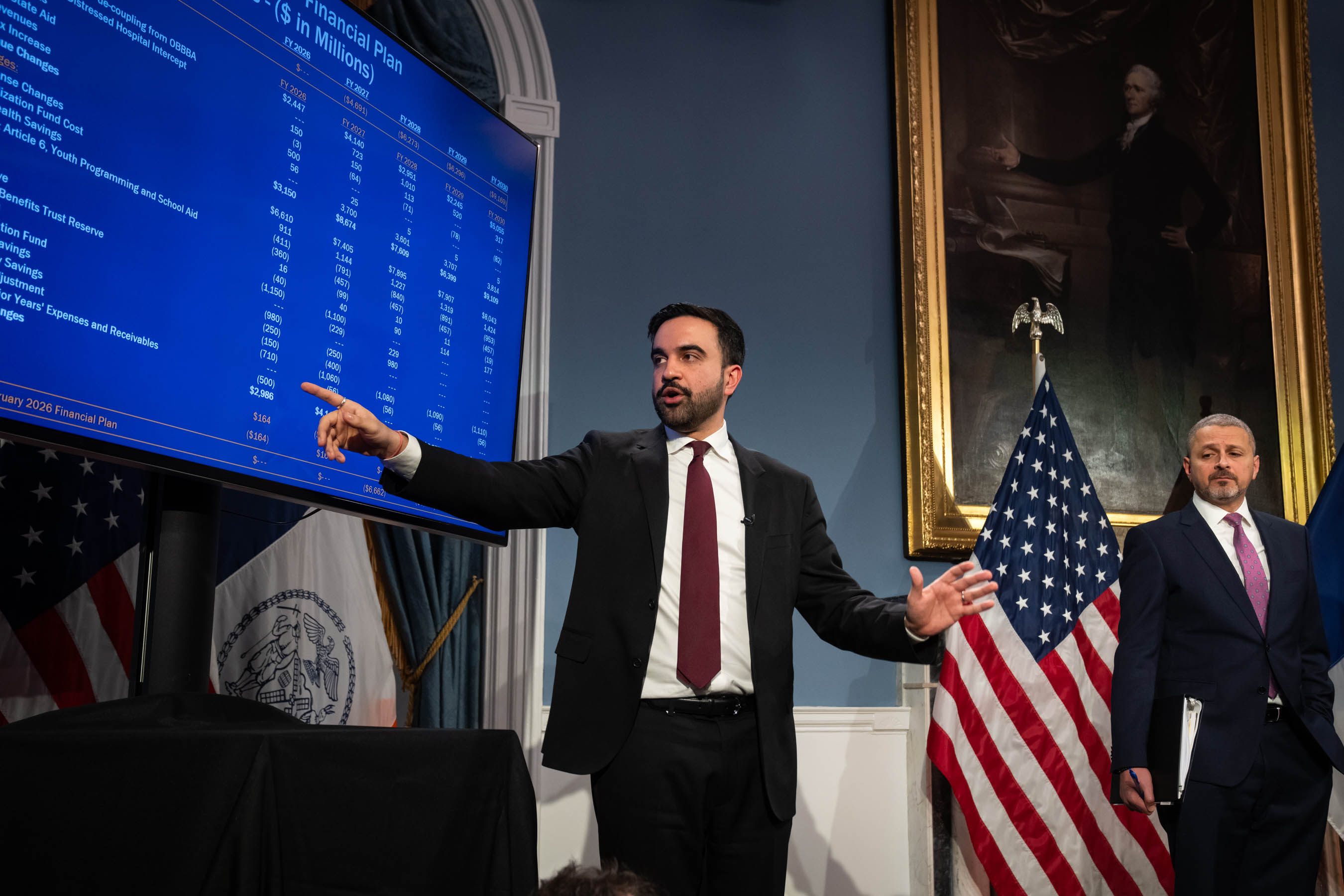
Mayor Zohran Kwame Mamdani released a $127 billion FY2027 Preliminary Budget confronting an inherited budget shortfall that widened to roughly $12 billion across FY2026–FY2027. After $1.77 billion in agency savings, a $7.3 billion upward tax revenue revision, and $1.597 billion in State support, the City still faces a $5.4 billion two‑year gap; the plan assumes a 9.5% property tax rate increase to generate $3.7 billion in FY2027 and applies $980 million from the Rainy Day Reserve (FY2026) and $229 million from the Retiree Health Benefit Trust (FY2027). The administration’s preferred solution is recurring revenue via higher personal income taxes on earners >$1M and higher taxes on profitable corporations, with a $113 billion five‑year capital plan including $662 million for affordable housing preservation and $48.2 million for Bellevue renovations.
Market-structure: The Mayor’s plan shifts fiscal burden risk from high earners/corporates toward property owners if revenue authority is blocked; the city assuming a 9.5% property tax rate increase (≈$3.7B in FY27) signals direct pressure on NYC real-estate cash flows and local consumer spending. Residential and office landlords with concentrated NYC holdings will be first-order losers while Sun Belt and suburban housing markets may capture migration/relative demand gains as high-earners reprice location choice.
Risk assessment: Tail risk includes a failed negotiation with the State that forces deeper reserve draws or a >10% effective tax hike, which could spike NYC municipal credit spreads and depress local asset prices. Near-term (30–90 days) volatility centers on state funding/legislative outcomes; medium-term (6–18 months) effects include migration-driven demand shifts and cap-rate repricing for NYC commercial and multifamily assets.
Trade implications: Expect widening NYC muni vs. Treasury spreads and weaker rent growth in expensive micro-markets; banks and CRE lenders with concentrated NYC CRE loans face credit stress. Relative-value opportunities: short NYC-centric REITs and go long national/Sun-Belt residential owners; hedge muni-duration risk and prefer shorter-dated muni exposure until state talks resolve.
Contrarian angles: Consensus assumes permanent outflow from NYC; that’s overdone if new revenue authority is secured (raising PIT/corporate taxes) and stabilizes finances — that outcome would tighten spreads and lift muni/REITs. Watch two catalysts that could flip the book: (1) Governor support/legislation in next 30–60 days; (2) a legal challenge to tax changes that would force deeper reserve use and widen spreads >25–50bps.
AI-powered research, real-time alerts, and portfolio analytics for institutional investors.
Request DemoOverall Sentiment
moderately negative
Sentiment Score
-0.40
