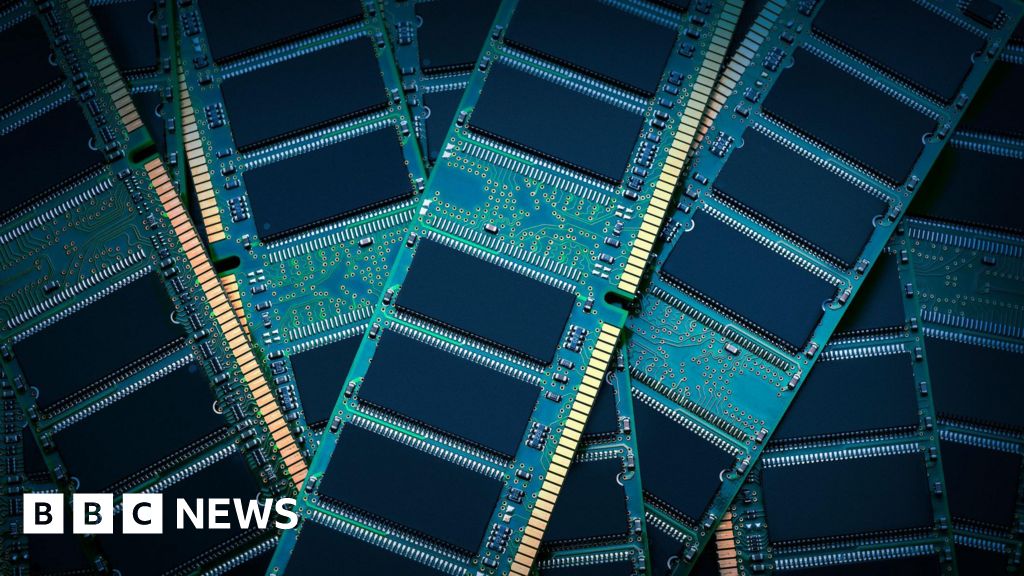
Surging AI-driven demand from hyperscalers has pushed RAM prices sharply higher—more than doubling since October 2025 and with some vendors quoting up to 5x increases—creating a material supply/demand imbalance across memory types. Memory, which historically accounted for 15–20% of PC cost, is now running 30–40% in some builds, prompting manufacturers to consider passing $40–$50 per 16GB laptop and roughly $30 per smartphone onto consumers; Micron has exited the consumer Crucial brand to prioritise AI demand, underscoring the sectoral reallocation of capacity likely to keep prices elevated into 2026–27.
Market structure: Memory suppliers (Micron MU, SK Hynix 000660.KS, Samsung SSNLF) are near-term winners as prices trade roughly 2x–5x Oct 2025 levels and memory now accounts for ~30–40% of PC BOM vs 15–20% historically. Losers include low‑margin PC/smartphone OEMs (HPQ, DELL, LNVGY) facing margin compression or forced price increases; hyperscalers (AMZN, GOOGL) have buying power but will raise capex. Cross-asset: tech input inflation raises equity dispersion in semis vs hardware, could lift semiconductor equities while pressuring consumer discretionary; modest upward pressure on breakevens could tighten IG spreads if margins fall.
Risk assessment: Tail risks include rapid supply additions (new fab ramps within 12–18 months) collapsing spot DRAM, or demand destruction if consumer volumes drop >10% in 2026; geopolitical export controls or consolidation (Micron refocus) are medium-probability, high-impact events. Time horizons: days–weeks = volatile spot and quotes; months (through H1–H2 2026) = OEM earnings shocks; multi‑year = structural HBM demand from AI. Hidden dependencies: OEM inventory days, hyperscaler multi-year contracts, and substitution to model optimization can blunt demand. Key catalysts: cloud capex bookings, MU/Samsung/Hynix earnings and guidance, monthly DRAM spot indices.
Trade implications: Direct: establish a 2–3% long in MU via 3–6 month call spreads (buy ATM, sell 20% OTM) to play pricing power; mirror exposure in 000660.KS/SSNLF if available. Short 1–2% positions or buy 3‑month put spreads in HPQ or LNVGY to hedge consumer hardware margin risk. Pair: long MU / short HPQ (dollar‑neutral) for 3–6 months. Options: buy calendar or vertical call spreads on MU to capture rising implied vol; sell covered calls on HPQ to collect premium. Enter within 2–6 weeks; exit/trim if DRAM spot falls >30% from current peak or after two consecutive quarters of declining supplier ASPs.
Contrarian angles: Consensus assumes a uniform memory shortage; the market may overlook bifurcation between scarce HBM (AI) and commodity DRAM — DRAM could collapse while HBM stays tight, creating mispricings within the sector. Reaction could be overdone on some OEM shorts if premium brands (AAPL) successfully pass $30–$50 build cost increases to consumers. Historical parallel: 2017–18 DRAM cycle reversed within ~12–18 months after capex; monitor supplier capex announcements and hyperscaler efficiency initiatives (model quantization) as early warning signals.
AI-powered research, real-time alerts, and portfolio analytics for institutional investors.
Request DemoOverall Sentiment
moderately negative
Sentiment Score
-0.45
Ticker Sentiment
