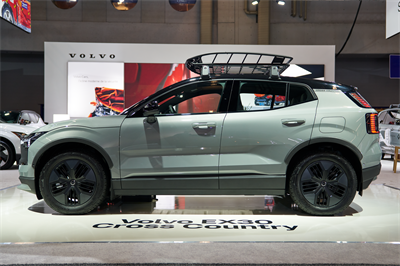
Volvo Cars Canada is presenting the new EX30 Cross Country at the Montreal International Auto Show (Jan 16–25, 2026), marking the Canadian auto show debut of the compact electric SUV which starts at CAD 59,800 and is now available to configure and place deposits; the exhibit also features the EX30, EX40, XC40, XC60 and XC90, with EX30/EX40 test drives. The launch reinforces Volvo's Canadian electrification strategy—with Quebec highlighted as a key market—and comes alongside Volvo Car Group's strong 2024 financials (core operating profit SEK 27 billion; revenue SEK 400.2 billion; global sales 763,389), supporting the company's product-led EV growth narrative.
Market structure: Volvo’s EX30 Cross Country launch in Quebec signals incremental penetration in a high-ARPU EV market where provincial incentives and cold-climate credibility matter; expect localized share gains versus other premium compact EVs (Tesla Model Y, BMW X1 EV equivalents) rather than material global volume shifts. Suppliers to Volvo’s EV program (battery and chassis component vendors) are the direct beneficiaries; dealers and Canadian retail financing desks could see higher ticket sizes (+~10–20% ASP lift versus non-Cross models). Pricing power is modest — Volvo’s One Price Promise limits promotional erosion but margin upside will depend on scale and supplier pricing.
Risk assessment: Tail risks include a Canadian incentive rollback, a supplier battery constraint, or a safety recall that could erase the product-launch bump; each would compress Volvo’s Canada EBIT by an outsized ~50–150 bps regionally over 2–4 quarters. Immediate impact is PR-driven and fades in days; meaningful sales/rate impacts should be assessed over 1–4 quarters as deposit-to-delivery conversion and retail order data appear. Hidden dependencies: dealer inventory pacing, provincial rebate schedules, and winter performance metrics (range/returns) will drive second-order effects on resale values and financing spreads.
Trade implications: Tactical long exposure to Volvo Car Group (VOLCAR-B.ST) and select battery suppliers (CATL 300750.SZ, LGES 373220.KS) for 3–12 month horizons is warranted, sized small (1–2% each) with clear stop-losses; consider a relative pair (long VOLCAR-B, short BMW.DE) to isolate Volvo-specific retail upside. Use short-dated call spreads (90-day) rather than naked calls to limit theta; avoid large duration exposure until Canadian monthly retail data for Jan–Mar 2026 confirms conversion rates above 20% of configurations to deposits.
Contrarian angles: Consensus will downplay a single-venue launch as immaterial — that misses the signal: strong uptake in Quebec can be a lead indicator for premium compact EV demand in cold climates and a template for North American rollouts. Risk that gains are overestimated is real: cannibalization of higher-margin XC40/40-series models could mute net corporate margin gains, and dealers’ financing margins may compress if subsidy-driven pricing proves transient. Historical parallel: niche crossover launches that succeed regionally (e.g., Subaru Crosstrek in cold markets) often precede broader margin realization after 4–8 quarters, not immediately.
AI-powered research, real-time alerts, and portfolio analytics for institutional investors.
Request DemoOverall Sentiment
mildly positive
Sentiment Score
0.35
