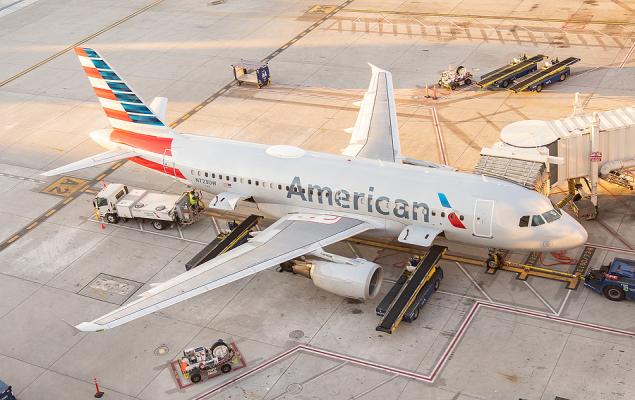
American Airlines (AAL) stock declined 10% despite comfortably beating Q2 revenue and EPS estimates, reporting $14.39 billion in sales and $0.95 EPS. The market reaction stems from the airline's cautious outlook and a significant cut to its full-year EPS guidance, now projected at a midpoint of $0.30, down sharply from a prior $1.70-$2.70, largely due to anticipated Q3 losses from weak domestic demand. While Q2 performance was bolstered by cost control and strong international/premium travel, this revised guidance signals ongoing demand uncertainty, leading to valuation concerns despite AAL's low price-to-sales ratio.
American Airlines' stock declined as much as 10% despite a second-quarter performance that exceeded expectations, a market reaction driven entirely by a severely weakened forward outlook. The company reported Q2 revenue of $14.39 billion and EPS of $0.95, beating consensus estimates of $14.28 billion and $0.79, respectively. This bottom-line beat was supported by disciplined cost control and lower fuel expenses. Positive operational drivers included strong international and premium cabin demand, highlighted by a 5% year-over-year increase in Atlantic passenger unit revenue, and growth in the AAdvantage loyalty program. However, these positive results were completely overshadowed by the company reinstating but sharply lowering its full-year earnings guidance to a range of -$0.20 to +$0.80 per share, a dramatic reduction from the previous forecast of $1.70 to $2.70. This revision is predicated on an anticipated adjusted loss in Q3 due to weak domestic demand. From a valuation perspective, the stock presents a mixed picture: its forward P/E of 17.4X is at a significant premium to peers like Delta (10X) and United (9X), while its price-to-sales ratio of 0.15X is substantially lower than the industry average.
AI-powered research, real-time alerts, and portfolio analytics for institutional investors.
Overall Sentiment
moderately negative
Sentiment Score
-0.35
Ticker Sentiment
