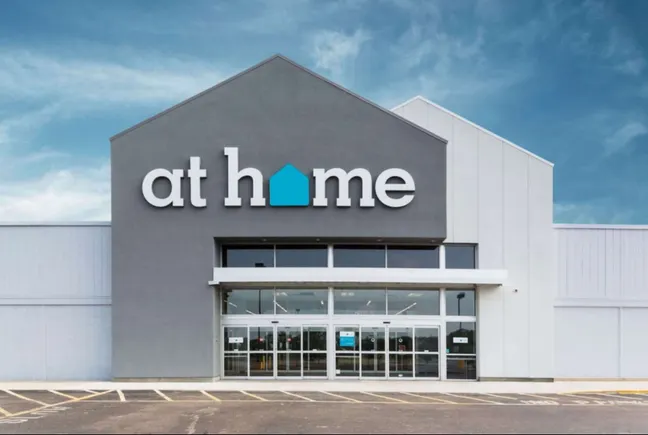
Home decor retailer At Home has filed for Chapter 11 bankruptcy, burdened by $2 billion in debt amid macroeconomic headwinds including the pandemic, supply chain disruptions, inflation, and tariffs. The company has secured a deal with lenders to eliminate its debt and obtain $600 million in debtor-in-possession financing. Despite a spike in demand during the pandemic, At Home faced challenges from supply chain issues, declining in-store traffic, and a shift in consumer spending towards essential goods, raising concerns about its long-term viability even after restructuring.
Furniture retailer At Home has filed for Chapter 11 bankruptcy protection, citing a confluence of adverse factors including the pandemic, persistent supply chain disruptions, inflationary pressures, and tariffs. The company, acquired by Hellman & Friedman four years ago for $2.8 billion including debt, carries $2 billion in debt, which is anticipated to be eliminated through an agreement with lenders. It has also secured $600 million in debtor-in-possession financing, comprising a $200 million infusion and a $400 million roll-up of existing senior secured debt. This restructuring occurs at a critical juncture, as 40% of At Home's net sales in its latest fiscal year were derived from holiday and seasonal items. Despite a pandemic-induced demand surge, subsequent cooling, severe supply chain burdens, and rising freight costs significantly impacted performance. Chief Financial Officer Jeremy Aguilar highlighted a 24% decline in in-store traffic at the start of this year compared to pre-pandemic 2020 levels, and noted a consumer shift towards essential goods amid economic uncertainty, impacting a business where the typical customer spends about $75 per visit on items averaging under $20. The company's heavy reliance on overseas sourcing, with approximately 90% of its products imported, has made it particularly vulnerable to tariff volatility, which exacerbated existing financial pressures. Industry analysts, such as GlobalData's Neil Saunders, express skepticism regarding At Home's post-bankruptcy prospects, pointing out that underlying macroeconomic challenges and intense competition from players like Ikea and Wayfair will persist. Saunders notes deficiencies in At Home's value proposition, citing a lack of in-store inspiration and insufficiently sharp pricing to draw its 70 million annual store visitors. Furthermore, the company's significant brick-and-mortar footprint, with 260 large-format stores generating 93% of sales revenue, and underperforming locations under lease, pose ongoing challenges despite cutbacks in new store openings. This is At Home's second bankruptcy, following a previous filing in 2004, underscoring persistent structural issues. While the proposed debt reduction offers financial respite, Saunders emphasizes that fundamental issues with the business model require a comprehensive reassessment for long-term viability.
AI-powered research, real-time alerts, and portfolio analytics for institutional investors.
Request DemoOverall Sentiment
strongly negative
Sentiment Score
-0.80
Ticker Sentiment
