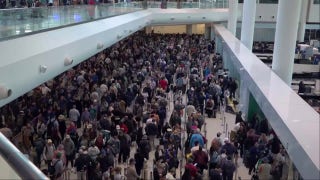
More than 400 TSA workers have quit since Feb. 14 and DHS reports >10% officer absenteeism on over half of the past seven days, with some airports averaging near 20% and Hobby exceeding 40%. Weekend checkpoint delays peaked at ~153 minutes in Atlanta, 75 minutes at JFK and 2–3 hour waits in Houston, forcing advisories to arrive 3–4 hours early and President Trump to propose deploying ICE to assist. The disruptions are driven by a DHS funding lapse and unpaid TSA staff amid the partial government shutdown, creating acute operational stress for the travel sector and heightened political conflict.
The immediate economic friction is not just lost minutes in security lines but cascading operational costs: missed connections force re-accommodation, extra crew pay, hotel vouchers and asset mis-allocations that magnify per-flight unit costs. If even 1–2% of daily itineraries convert to misconnects or cancellations for several weeks, legacy carriers’ short-term Opex could rise by a low-single-digit percentage while ancillary revenues (change fees, rebooking premiums) become more volatile and policy-dependent.
Winners will be firms that monetize the disruption or provide on-ramp alternatives — online travel agencies that capture last-minute rebookings and ground-transport/rental platforms that win modal share from irritated flyers. Losers are the most schedule-tight operators and hub-light carriers that rely on quick turnarounds; persistent unpredictability also accelerates airport automation procurement cycles and outsourcing of checkpoint tasks to contractors, shifting capex/opex budgets downstream to vendors of screening tech and service providers.
Key catalysts and timeframes: a funding fix within 7–14 days would likely normalize passenger behavior and compress option-implied volatility across airline equities; conversely, a protracted impasse (4–8+ weeks) materially raises tail risk — regulatory interventions, litigation over ICE deployment, or union actions — and could force airlines to pre-emptively shave schedules. Watch absenteeism trends and daily checkpoint throughput data as a real-time early-warning signal; each 5% incremental no-show rate materially increases probability of lane closures and schedule attrition.
The consensus frames this as a political stunt; the market should treat it as an operational shock with asymmetric downside for fragile operators and asymmetric upside for firms that sell substitution (ground mobility, OTAs) or hedging via short-duration derivative plays.
AI-powered research, real-time alerts, and portfolio analytics for institutional investors.
Request DemoOverall Sentiment
moderately negative
Sentiment Score
-0.55
